

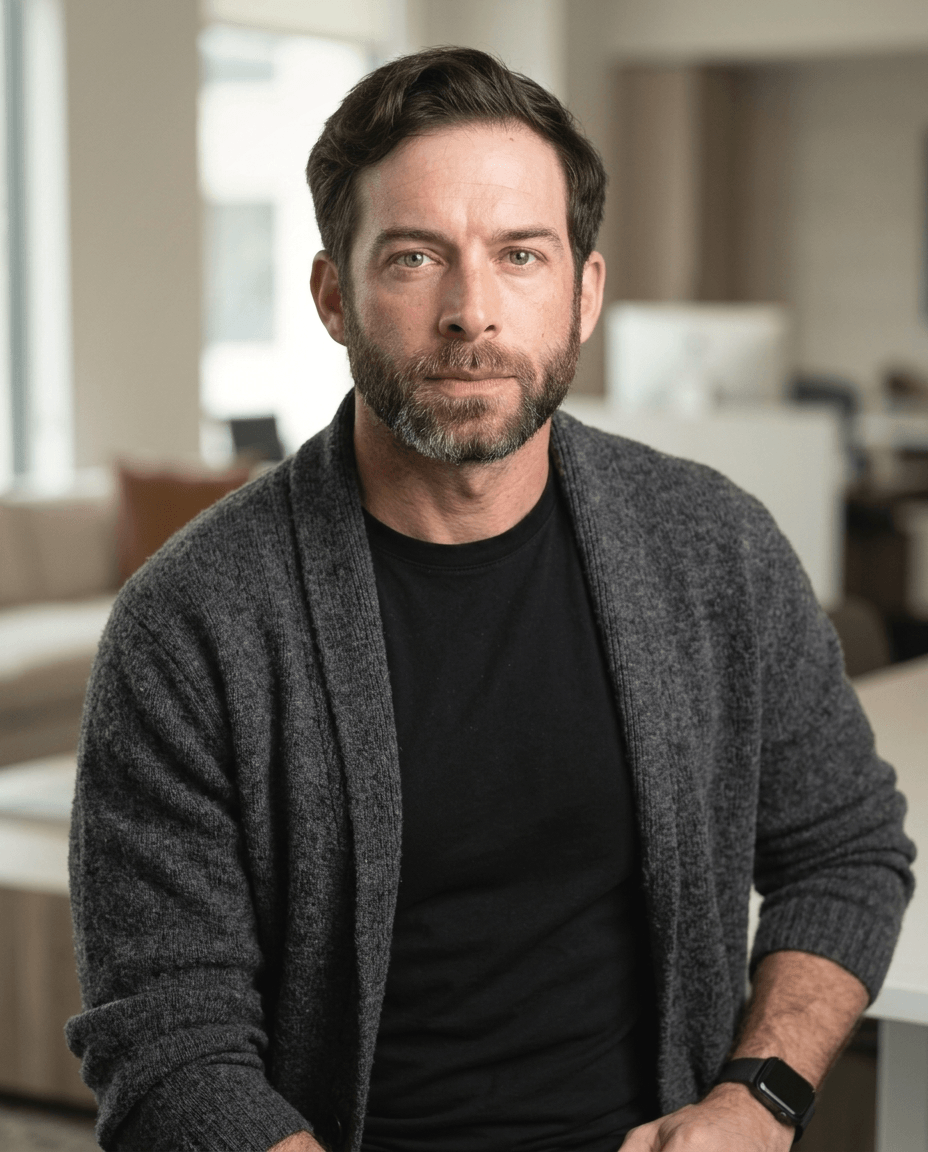


Team photos are a system, not a snapshot. Most team photo advice focuses on poses. That's the wrong problem to solve. A key challenge is consistency, scale, and logistics, especially with remote teams.
Visual content drives 94% more views than text-only posts, and real team photos increase engagement by 35% compared to stock images, according to the analysis summarized in this team photo guide. That's why strong team pictures ideas start with repeatable standards, not one clever group pose. After photographing 10,000+ professionals at our Houston studio through Studio Pod since 2019, we learned the same lesson again and again. Teams need a visual identity system they can maintain.
That's why we built AiHeadshots. We're photographers Joseph West and Hunter Casner, and our team built an AI product from real studio practice, not from a software-first shortcut. The result is simple. You upload 10 to 20 phone selfies, skip the studio visit, and get 30+ studio-grade headshots in about 30 minutes. If you want a useful outside reference on culture imagery, this glimpse into Pebb's culture shows why consistent people photography matters beyond the About page.
Table of Contents
- 1. Individual headshots with consistent branding
- 2. Casual team lineup with personality
- 3. Executive-tier headshots for leadership
- 4. Remote team photos with global diversity
- 5. Departmental team groupings with split layouts
- 6. Behind-the-scenes candid series with professional polish
- 7. Industry-specific styling for professional sectors
- 8. LinkedIn profile optimization with multiple expressions and backgrounds
- 9. Recruitment and candidate pipeline imagery
- 10. Tiered and scalable photography for growing teams
- 10 Team Photo Ideas Compared
- One system for every team, everywhere
1. Individual headshots with consistent branding
The strongest team page usually starts with one person at a time. Uniform crop. Uniform background. Uniform lighting. That's what makes a 6-person company look organized, and it's what keeps a 600-person company from looking stitched together.

We use this approach constantly for firms that need website bios, LinkedIn profiles, speaker pages, and proposal decks to match. Tech teams use it to standardize engineering directories. Law firms use it to stop the patchwork look where one attorney has a formal studio portrait and another has a cropped vacation photo.
Make the system visible
Set the rules before anyone uploads a photo. Pick one background tone. Pick one retouching style. Pick one framing standard. Then keep it fixed across every hire.
Practical rule: If one person gets a charcoal background and another gets bright white, your brand looks accidental.
AiHeadshots works well here because the workflow is built for repeatability. You upload clear selfies in natural light, review 30+ options, and select a final set that matches the rest of the team. Our photography background matters here. Studio Pod shot 10,000+ professionals before AiHeadshots existed, so our system was trained around what real corporate portrait consistency requires.
2. Casual team lineup with personality
Not every team should look like a boardroom roster. Some brands need polish with warmth. That's where casual team pictures ideas outperform stiff headshots.
A design agency, startup, or nonprofit often benefits from softer expressions, relaxed posture, and lifestyle backgrounds that still keep the face clean and prominent. You want approachability without losing discipline. Blurred office context works. Outdoor backgrounds can work too, if every portrait still feels like it belongs to the same company.

What doesn't work is fake candid energy. Forced laughter reads instantly. So do overdone poses. The better route is relaxed eye contact, natural smiles, and slight pose variation across the set.
Keep casual under control
Team leads usually overshoot. They want personality, then they approve photos with inconsistent color, random crops, and five different visual moods. A casual set still needs structure.
For bigger groups, use a workflow built for volume instead of passing phone snapshots around Slack. Our team headshots workflow for distributed companies is designed for that. It gives marketing and HR one standard across the whole company, without booking a studio day for every office.
3. Executive-tier headshots for leadership
Leadership photos carry more jobs than staff portraits do. They land on investor decks, press releases, keynote pages, media kits, and board bios. That changes the styling.
Executives need more control in wardrobe, expression, and backdrop selection. Darker neutrals usually photograph better for that audience because they hold authority without distracting from the face. The photo should feel composed, not severe.
Polish matters more at the top
A C-suite set should look quieter and more deliberate than the rest of the company gallery. We usually recommend one outfit family, one background family, and restrained retouching. Skin should still look like skin. The goal is credibility.
The best executive portrait looks expensive because it feels intentional, not because it looks heavily edited.
If you're choosing wardrobe for a leadership refresh, our executive headshot wardrobe guide covers the decisions that affect authority on camera. AiHeadshots is especially useful here because the same selfie set can generate multiple polished options for annual reports, LinkedIn, and press use without scheduling repeat sessions. That speed is one of the reasons adoption of AI headshot tools has grown significantly, with a verified summary noting a 68% global surge between 2023 and 2025 and a 91% user satisfaction rate on image quality.
4. Remote team photos with global diversity
Old team photography falls short. One office in New York is manageable. A company with staff across three or more locations isn't. A verified 2024 McKinsey survey summary found that 62% of mid-sized companies now operate hybrid teams across 3+ locations. Traditional group shoots don't scale well in that reality.
The fix isn't to lower standards. It's to move the standard upstream. Give everyone the same upload instructions, outfit guidance, and background rules, then collect consistent portraits remotely.
Build the brief before the pictures
A one-page photo brief solves most problems. Tell people to use daylight from a window. Tell them what not to wear. Show example crops. Set a deadline by time zone, not by headquarters.
This approach works well for SaaS companies with engineering teams across regions, consulting firms with multiple offices, and remote-first startups building their first team directory. AiHeadshots makes the logistics manageable because nobody needs a studio visit. Team members upload 10 to 20 selfies from wherever they are, and the company gets a unified result instead of a folder full of mismatched images.
5. Departmental team groupings with split layouts
A flat wall of headshots gets hard to scan once the company grows. Departmental grouping fixes that. It also helps visitors understand the organization faster.
We've seen this work especially well for financial services firms that sort by region, healthcare groups that sort by specialty, and law firms that sort by practice area. The photo itself doesn't need to change much. The structure around it does.
Use the layout to reinforce hierarchy
Keep the crop identical, then use page design to do the sorting. Department headers. Clean spacing. Titles under names. Sometimes a subtle background variation by function can help, but only if it stays within the brand palette.
There's also a long photographic logic behind ordered group presentation. Structured team photography has used row systems, pyramid formations, and visibility planning since the late 19th century, with row-based layouts becoming mainstream by the 1920s and “windows” between rows documented by the 1950s, as summarized in this history of team posing. Digital team directories are different from school or sports portraits, but the same principle still applies. Order makes people easier to see.
6. Behind-the-scenes candid series with professional polish
Formal portraits handle trust. Candid photos handle texture. The best team pages use both.

A consulting firm can pair partner headshots with meeting-room candids. A nonprofit can pair staff portraits with program photos. A tech company can place executive headshots beside product and collaboration imagery. That combination answers two different questions. Who are these people, and what does it feel like to work with them?
Don't replace headshots with candids
This is the mistake. Teams post only culture photos and think they've solved branding. They haven't. Candid images are supportive assets. They don't replace a clean portrait for bio pages, speaking appearances, or LinkedIn.
Keep the candid backgrounds simple. Use intentional light. Direct people lightly, then let the action breathe. The final set should feel related to the headshots in tone and color, even if it's more relaxed.
A short example of polished people photography in motion helps here:
What matters is the pairing. Studio-quality portraits for formal use. Real environment images for story.
7. Industry-specific styling for professional sectors
Different sectors need different signals. The fastest way to make a headshot feel wrong is to copy a style that belongs to another field.
A therapist usually benefits from softer light and warmer backgrounds. A lawyer usually needs cleaner lines and more formal wardrobe. A physician can use attire and setting that signal professionalism without turning the portrait into costume. Realtors often need the most balanced mix of polish and approachability because their image appears across listings, social channels, and personal branding.
Match the field, not the trend
We advise clients to compare against direct competitors before choosing a style set. Not to mimic them. To understand the visual language buyers already associate with trust in that category.
A strong professional portrait doesn't show your personality in the abstract. It shows your role clearly.
This is another place where our photography-first background matters. Joseph West and Hunter Casner built AiHeadshots after years inside Studio Pod, working with real professionals who needed different looks for legal, medical, consulting, real estate, and wellness work. That's different from retrofitting a generic image model and hoping it understands sector cues.
8. LinkedIn profile optimization with multiple expressions and backgrounds
LinkedIn needs options, not one forever photo. The strongest personal branding sets include a few usable looks that stay within the same identity.
That doesn't mean reinventing yourself every month. It means keeping a serious version, a warmer version, and perhaps a different background for different contexts. A recruiter, consultant, founder, or sales lead often needs a profile image that's more formal than the images they use in posts or speaker bios.
Build a small working library
Use slightly different selfie angles and distances in the upload set. That gives AiHeadshots more material to work with. Then shortlist a handful of finals instead of trying to crown one perfect image.
A verified summary of professional image expectations notes that 78% of job seekers feel their LinkedIn profile is weakened by inconsistent or low-quality imagery, while only 12% of companies provide standardized headshot tools. That gap is why individual professionals end up managing this themselves. Our LinkedIn headshot guide for 2026 breaks down how to choose the right expression, crop, and background without drifting away from your core look.
9. Recruitment and candidate pipeline imagery
Hiring pages usually fail in one of two ways. They're all stock photography, or they're all informal snapshots. Neither creates trust.
Candidates want to see real people in real roles. They also need those images to look intentional. That's especially true when you're hiring across technical, administrative, and leadership functions at the same time. One visual system can hold that together.
Show the company you actually are
Mix employee headshots with job titles, short bios, and a few culture images from the workplace. Feature more than leadership. Include engineers, coordinators, clinicians, account managers, and operators. People want to see peers, not just executives.
If your careers team is sharing images by email and internal docs, practical file handling matters too. This guide to offline file compression for professionals is useful when teams need to send image sets around without clogging inboxes.
For companies hiring at speed, AiHeadshots gives recruiting and marketing one less production problem. No photographer calendar. No retouching queue. Just a clean, consistent people library that can keep up with new roles.
10. Tiered and scalable photography for growing teams
The smartest rollout usually isn't all at once. It starts with leadership, then hiring managers, then the rest of the staff in waves.
That pacing keeps costs controlled and standards intact. It also matches how companies actually grow. Founders need photos first. Then the first sales hires. Then the rest of the team once the headcount and website both expand.
Price and process have to scale together
A traditional photographer day rate runs about $300 to $600+ before you even get a single finished picture. That can work for one office on one day. It falls apart when hires are staggered across months and locations.
AiHeadshots starts at Basic pricing of $29, with Professional at $39, Executive at $59, and Teams pricing at volume rates for 10+ seats. We deliver 30+ studio-grade headshots in about 30 minutes, and every customer gets a 100% money-back guarantee within 14 days. For growing companies, that means you can document photo standards once, onboard new hires into the same system, and keep the brand coherent without waiting for the next company photo day.
10 Team Photo Ideas Compared
| Option | 🔄 Implementation complexity | ⚡ Resource requirements (cost / inputs / speed) | ⭐ Expected outcomes / quality | Ideal use cases | 💡 Key advantages & tips |
|---|---|---|---|---|---|
| Individual headshots with consistent branding | Low–Moderate, standardized workflow, easy scaling | $29–$59/person; upload 10–20 selfies; ~30 min turnaround | High, cohesive, polished team portraits | Company websites, LinkedIn, marketing materials, large directories | Scalable and cost‑effective; tip: choose one background color and review 30+ variations |
| Casual team lineup with personality | Low, relaxed direction, minimal staging | Low inputs; platform-driven variations; quick edits | Medium–High, approachable, humanized imagery | Startups, creative agencies, recruiting collateral | Humanizes brand for recruiting; tip: use blurred/outdoor backgrounds and lighter retouching |
| Executive-tier headshots for leadership | Moderate, specific wardrobe and retouching guidance required | $59/person (Executive); high‑res outputs; remote friendly | Very High, authoritative, investor‑grade portraits | C‑suite profiles, annual reports, press materials, board packages | Signals leadership credibility; tip: request executive backgrounds and polished retouching |
| Remote team photos with global diversity | Low, distributed uploads, coordination across time zones | Volume pricing $22–$29@10+; no studio travel; allow staggered uploads (2–3 days) | High, consistent, inclusive director ies across regions | Fully remote companies, global engineering or consulting teams | Eliminates scheduling friction and lowers cost; tip: provide a one‑page photo brief and use daylight window light |
| Departmental team groupings with split layouts | Moderate, requires org planning and standardization | Individual headshots optimized for grids; may use volume pricing | High, organized directories optimized for digital/print grids | Intranets, org charts, departmental pages, printed team posters | Aids navigation of org structure; tip: standardize crop/sizing and background per department |
| Behind-the-scenes candid series with professional polish | Moderate–High, coordinate studio and candid shoots | Mix of studio-grade headshots and candid captures; some internal photography | High engagement, balances credibility with relatability | Websites, social storytelling, marketing campaigns | More engaging than headshots alone; tip: keep candid lighting intentional and color‑grade to match headshots |
| Industry-specific styling for professional sectors | Moderate, requires sector research and tailored guidance | Tailored backgrounds/wardrobe; remote-friendly; variable cost | High, signals sector-appropriate trust and expertise | Medical, legal, real estate, therapists, client-facing professionals | Builds instant credibility within a sector; tip: study competitor norms and request appropriate retouching levels |
| LinkedIn profile optimization with multiple expressions and backgrounds | Low, one session yields many variations | $29–$59; upload 15–20 varied selfies; delivers 30+ variations | High versatility, many curated options to match content moods | Recruiters, thought leaders, sales professionals, job seekers | Generates a year's worth of images; tip: bookmark 5–8 favorites and rotate monthly/seasonally |
| Recruitment and candidate pipeline imagery | Moderate, combines headshots, culture images, testimonials | Volume pricing $22–$29@10+; ongoing updates and coordination | High, improves applicant quality and employer brand | Careers pages, job postings, hiring campaigns, employee spotlights | Boosts candidate attraction and lowers recruiting costs; tip: feature diverse roles, pair photos with testimonials, update quarterly |
| Tiered and scalable photography for growing teams | Low–Moderate, staged onboarding and batch scaling | Per‑person $29–$59; volume discounts at 10+; no minimums | High, consistent visuals that scale with hiring | Startups scaling from founders to full teams, rapid‑growth firms | Aligns photo spend with hiring velocity; tip: integrate headshot capture into onboarding and batch hires to secure discounts |
One system for every team, everywhere
A great team page isn't a collection of one-off photos. It's a visual system that communicates professionalism and cohesion. This marks the shift behind better team pictures ideas. Stop thinking about a single shoot. Start thinking about repeatable standards that survive hiring, promotions, remote work, and brand updates.
That's also why old advice about jumps, stair poses, and one big annual group photo misses the operational problem. Companies need team imagery that can scale across departments, offices, and new hires. They need portraits for websites, LinkedIn, sales decks, recruiting pages, intranets, and press use. They need those images to match even when the people were never in the same room.
We built AiHeadshots from that exact need. Studio Pod has photographed 10,000+ real professionals in Houston since 2019. That studio experience shaped the product. Joseph West and Hunter Casner didn't come at this as a software team looking for a photo category. We're photographers who built a system around the standards clients already expect from real portrait work.
That's also why our edge is specific. You upload 10 to 20 phone selfies. Our system delivers 30+ studio-grade headshots in about 30 minutes. No studio visit required. Teams can buy seats in volume. Individuals can start at $29. We've served 30,000+ customers, delivered 255,000+ headshots, and maintain a 4.9★ rating. If you want to review the look before you commit, browse our headshot examples, read customer AiHeadshots reviews, or learn more about our Studio Pod background.
The operational details matter too. Inputs are retained for 7 days, outputs for 30 days, and billing records for 90 days. That gives teams enough room to review and download without leaving files sitting around indefinitely.
The best team photo system is the one your company will maintain. Coordinating a photographer for a distributed team is a logistical and financial drain. Day rates run $300 to $600+ before you even get a single picture. AiHeadshots solves that for teams of 10 or 10,000. Upload 10 selfies, see your first headshot in 30 minutes, $29.
AiHeadshots gives you photographer-built headshots for LinkedIn, team pages, executive bios, and company directories. Upload 10 selfies, review 30+ studio-grade options in about 30 minutes, and keep your whole team on one visual standard at try AiHeadshots.