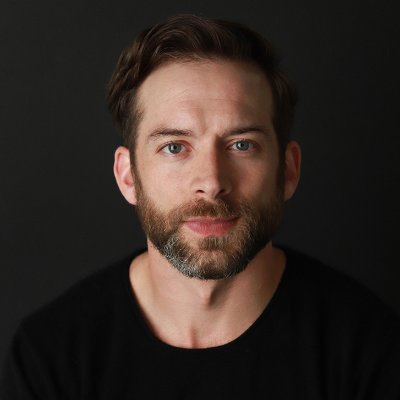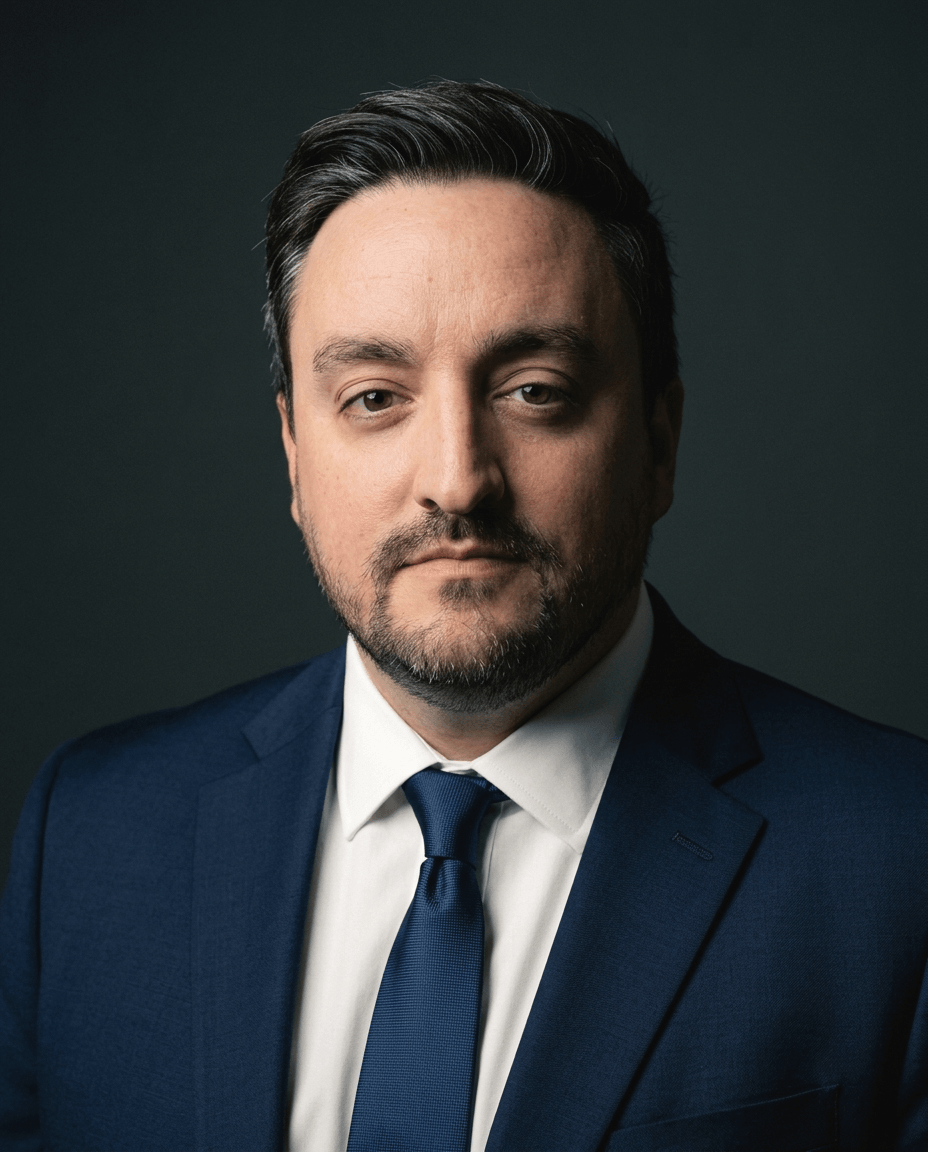
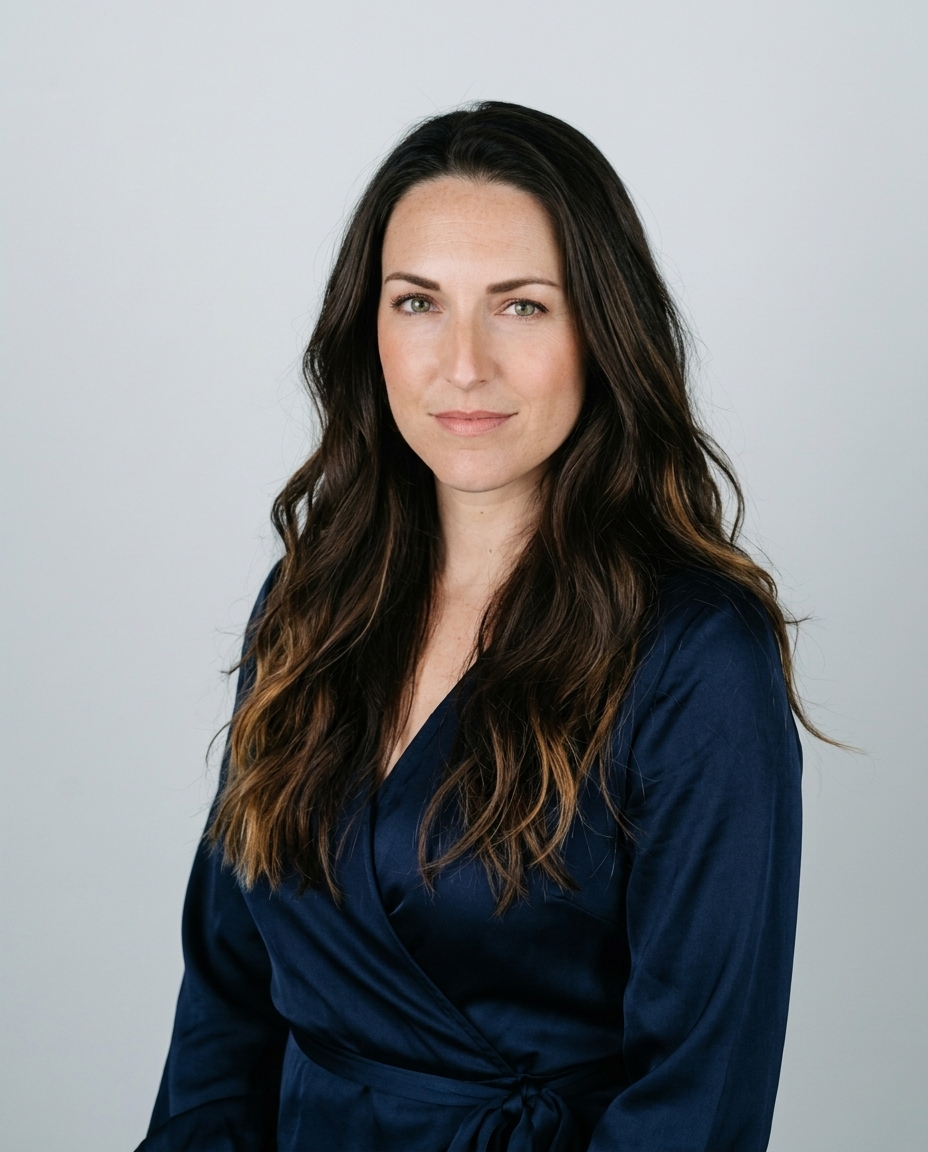
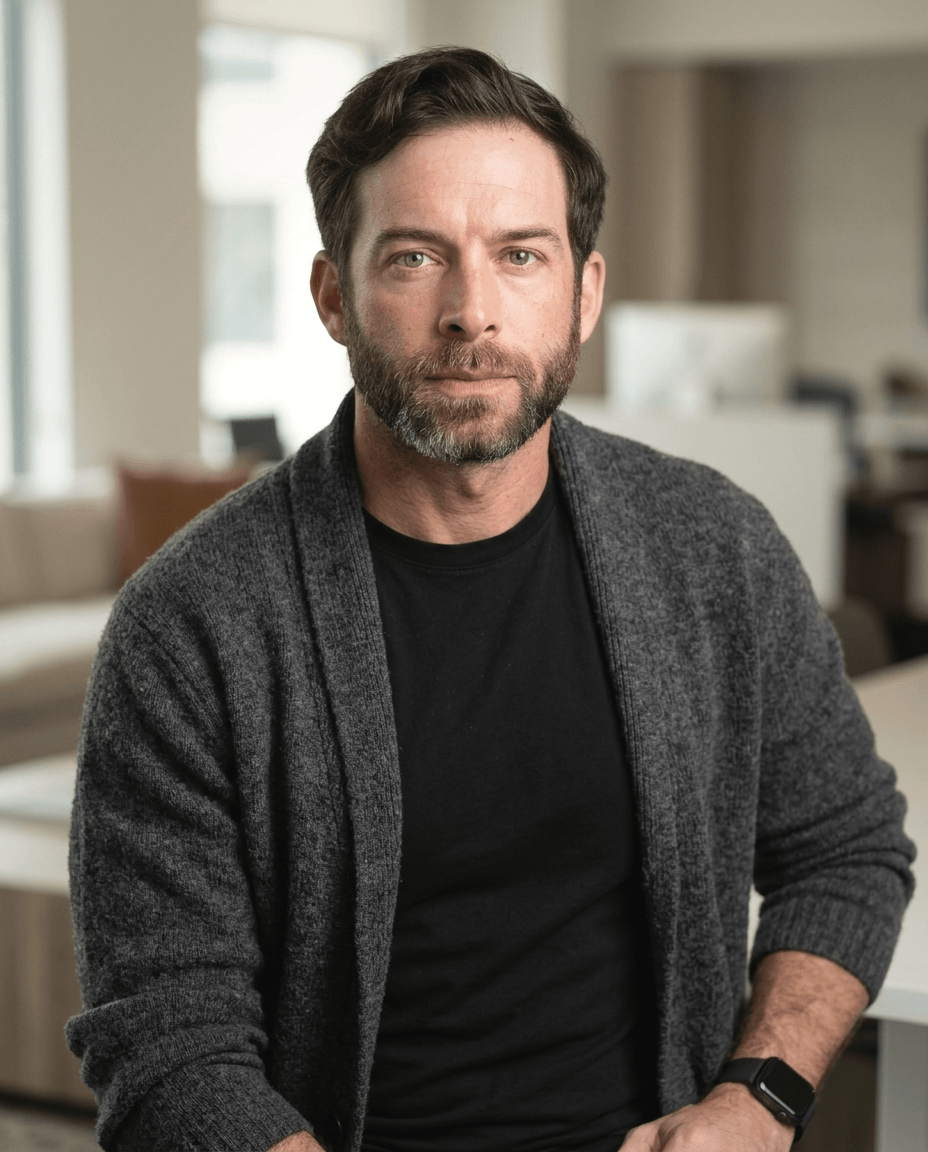
A sharper headshot isn't necessarily a better headshot. Face-image-quality research treats pose, illumination, facial geometry and usable facial area as separate quality factors. Professional headshot AI should meet the same standard as a photographed portrait: believable light, recognizable features and retouching that doesn't turn you into someone else.
Table of Contents
- Which fits your photo
- How AiHeadshots turns selfies into a finished set
- What makes an AI headshot look real
- Where AI headshots fit LinkedIn, executives and teams
- Disclosure, identity and appearance bias
- Choosing an AI headshot provider without guesswork
Which fits your photo
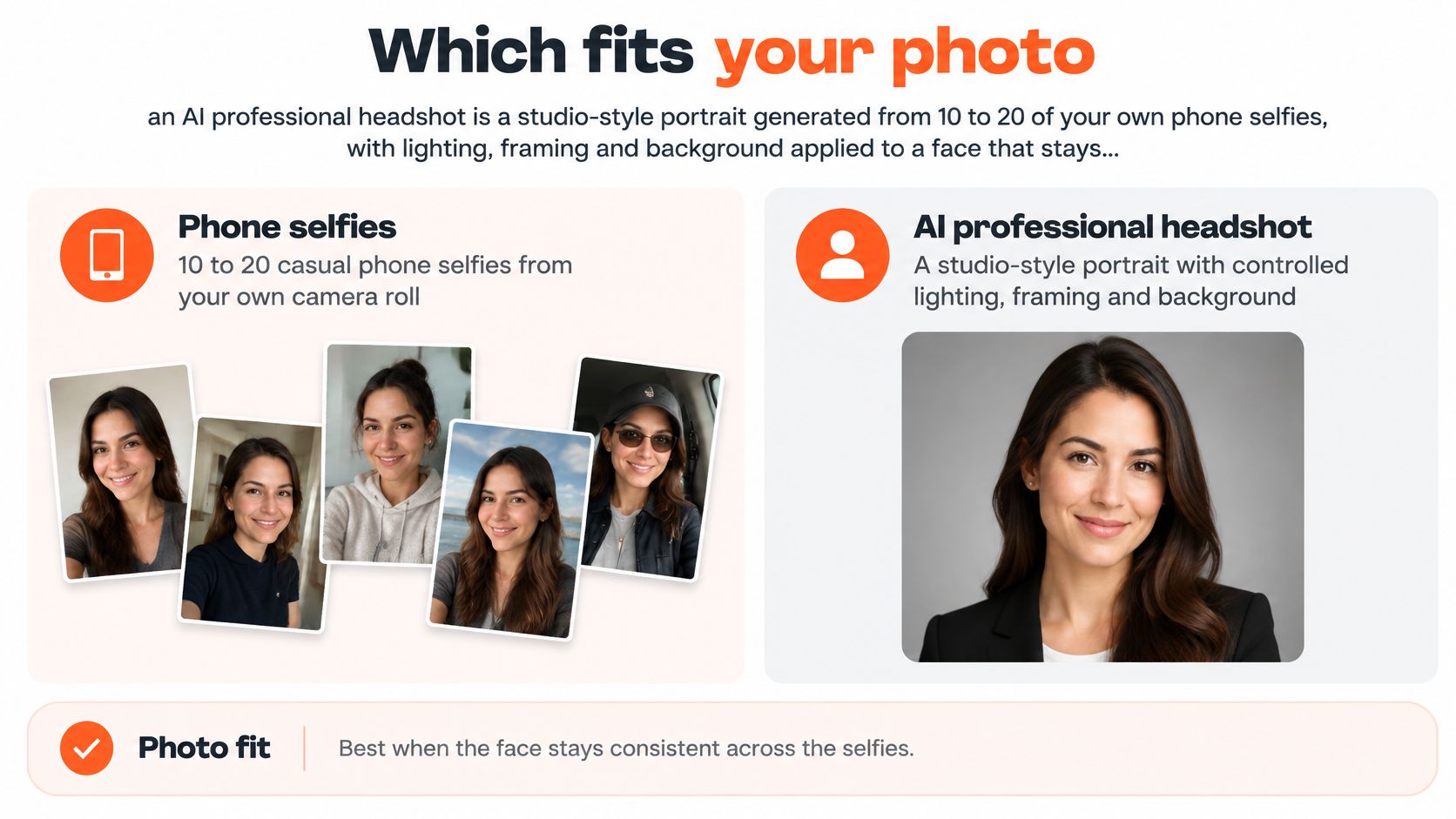
An AI professional headshot is a studio-style portrait generated from 10 to 20 of your own phone selfies, with lighting, framing and background applied to a face that stays yours. It fits a profile, directory or team page when you need a finished portrait without arranging a studio visit. A photographer fits work that requires on-camera movement, wardrobe changes and live direction.
AiHeadshots generates 30 or more finished headshots from the selfies you supply and emails you when the pack is ready. The advantage is choice: multiple looks in one set, no booking, no travel, no shoot. The trade-off is that you supply the reference material. Weak selfies produce a polished image of someone who may not be you, because the model has nothing reliable to preserve.
The comparison below shows the intended transformation.
AI headshots, photographer and DIY compared
| Option | Typical cost | Turnaround | Your time |
|---|---|---|---|
| AiHeadshots Professional | $39 | Emailed to you when the pack is ready | Upload 10 to 20 phone selfies |
| Photographer session | Quoted session and retouching fee | Booking and delivery schedule set by the photographer | Booking, travel, shoot and selection |
| DIY phone photo | Free with your existing phone | Same day if you get a usable frame | Set up lighting and background, then shoot and review retakes |
A DIY portrait gives you control over where you stand, the background and the direction of available light. What it doesn't give you automatically is controlled fill light, flattering camera distance or consistent framing. Start beside a large window, turn off mixed-color overhead lights and move the phone away from your face. A close, wide-angle selfie flattens facial geometry and shouldn't serve as your business portrait.
Choose by the assignment
For a straightforward profile update, start with the least complicated option that meets your standard. LinkedIn, Zillow, Compass, hospital staff directories and most corporate websites accept AI headshots without disclosure when they look photoreal, while medical fellowship applications and certain casting platforms require you to state that the image is AI-generated. For a campaign built around gestures, products or interaction, book a photographer. Generated portraits can't replace directing a person through an assignment.
Before ordering, check the publication's disclosure requirements, decide what edits you're comfortable presenting and choose recent reference photos. Our selfie preparation guide covers the inputs that produce a reliable result.
We offer a free preview before purchase and a 15-minute call if you want to discuss fit. The Professional plan is $39 for 50 finished headshots in 5 looks, including an outfit and up to 4 backgrounds. If a pack doesn't look like you, we re-train the model free on better selfies before any refund.
Upload 10 to 20 selfies and get 50 finished headshots in 5 looks for $39, or compare pricing.
How AiHeadshots turns selfies into a finished set
A finished set succeeds or fails at two gates: the quality of the selfies going in and the likeness coming out. AiHeadshots was built by Joseph West and photographers with years of hands-on studio experience at Studio Pod, and the workflow reflects that background. Inputs are controlled first, outputs are checked second, and nothing ships without your approval.
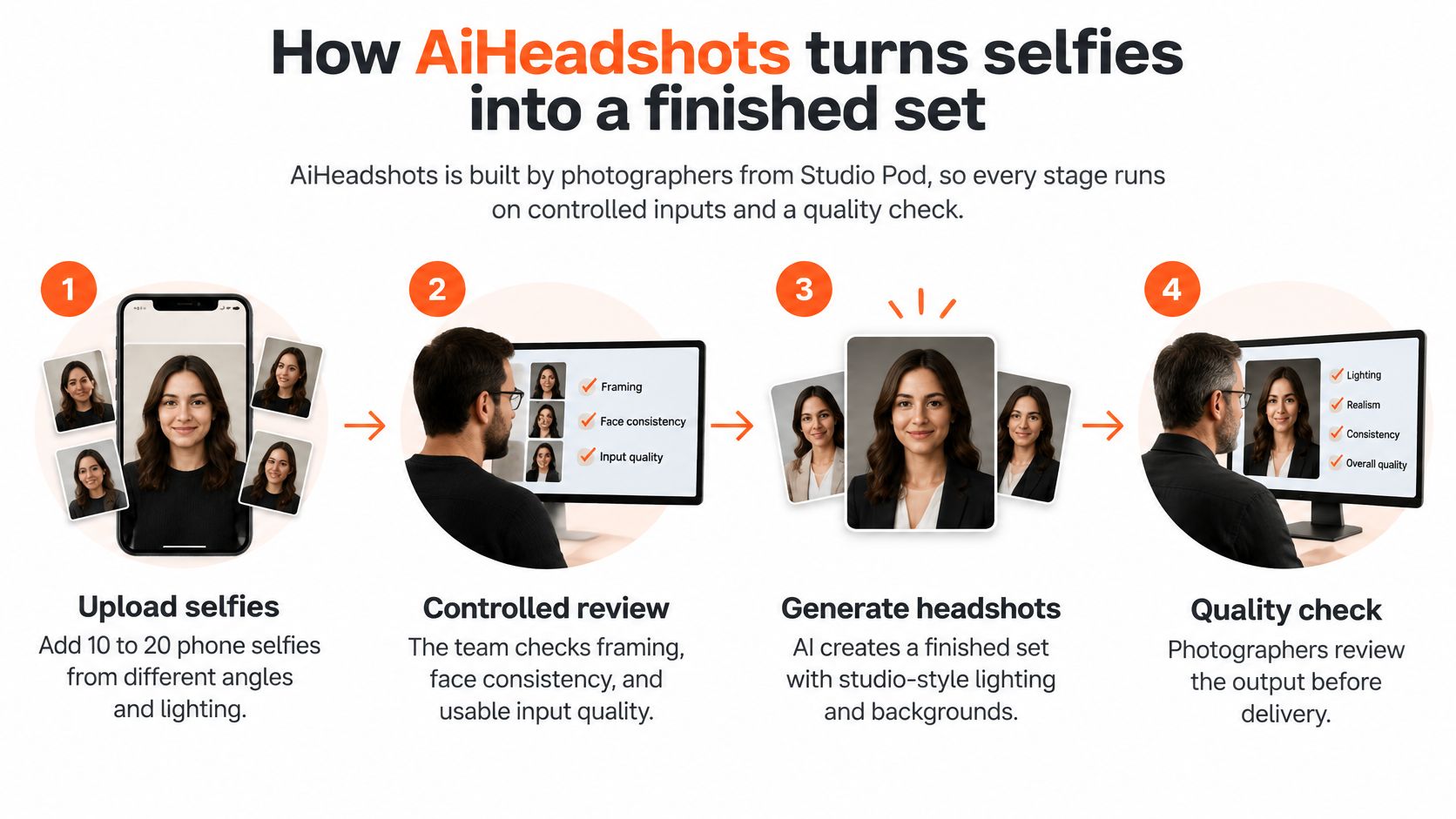
- Upload your selfies. Supply 10 to 20 casual phone photos at varied angles, in even daylight, without filters, sunglasses or heavy shadows. Several references let the system separate stable facial features from pose and lighting.
- Choose styles and backgrounds. Pick settings appropriate to where you'll publish the portrait. A restrained directory image and a speaker portrait serve different purposes.
- Check input quality. The system evaluates pose, exposure, occlusion and usable facial area before generation. Weak references shouldn't determine the finished face.
- Generate the set. AiHeadshots creates 30 or more headshots in your selected looks, giving you alternatives in expression and framing rather than a single take-it-or-leave-it result.
- Check generated variants. Outputs are evaluated for uneven illumination and altered facial geometry. A polished frame doesn't pass just because its background looks expensive.
- Receive your email. You get a message when the pack is ready, so there's no need to stay on the generation screen.
- Review your likeness. Compare the results with your current appearance before publishing. If the pack doesn't look like you, the first fix is a free re-train on better selfies, with a refund behind it.
Why quality gates matter
A published face-image-quality study scores source images on a 0–100 scale and classifies 60 or above as high quality. That is a research framework, not a claim that AiHeadshots applies those exact thresholds. The useful principle stands on its own: grade the reference photos and the finished portraits separately, because good inputs and good outputs fail in different ways.
For teams, output checks keep exposure, face scale and background separation consistent across a whole directory. Individually attractive portraits still look unrelated when those three drift between people.
Watch the service walkthrough to see the upload-to-delivery process.
Delivery standard: The face matches, the light falls evenly and the edges stay clean.
What makes an AI headshot look real
Lighting establishes facial form. The placement of light and shadow, and their relative areas, determines whether cheeks, nose and jaw read as dimensional or flat. Research on artistic portrait lighting identifies those relationships as central to visual appeal and the impression of three-dimensional shape.
Realism is also the practical bar. LinkedIn, Zillow, Compass, hospital staff directories and most corporate websites accept AI headshots without disclosure when they look photoreal, so the quality of the likeness decides where the image can go.
That's why we judge portraits through photography first. AiHeadshots comes from the photographers behind Studio Pod, an automated headshot studio in Houston opened in 2019. We're photographers who built an AI. Other AI headshot companies are software teams retrofitting open models on scraped internet photos, and the difference shows in how the light behaves.
Quality checks for an AI headshot
| Check | What good looks like | Failure sign |
|---|---|---|
| Head pose | Frontal to slight turn, eyes level | Strong turn, tilt or lean off-axis |
| Lighting balance | Key and fill light so both cheeks read evenly | One side much darker than the other |
| Sharpness | Eyes and hairline crisp at full size | Blur that wipes out fine hair and skin detail |
| Face scale and framing | Face fills a consistent share of the frame | Face size drifts between images in one set |
| Facial geometry | Eye spacing, nose and jaw match your selfies | Features shift, or the face looks like someone else |
| Background separation | Clean edge between hair and background | Halos, merged edges or uneven tone |
Inspect the face before the finish
Start with pose. A slight turn should change perspective, not reshape the jaw. Check lighting next: balanced fill doesn't mean eliminating every shadow. You need enough shadow to describe form, without losing an eye or cheek in darkness.
Flat light is the most common giveaway. It reads as a phone filter, not a studio.
Then inspect sharpness at full size, because thumbnails hide waxy skin and softened hairlines. Check framing across the whole pack, not just the strongest frame. Compare eye spacing, nose shape and chin against your selfies. Finally, inspect hair against the background, especially around curls, flyaways and glasses, where generated edges tend to smear or halo.
Our guide to AI photos that look real explains these photographic cues in more detail. Use the output examples to calibrate your eye for framing and finish, rather than judging from a small thumbnail.
Place the finished portrait beside recent photos of yourself. If you need to explain why the face looks different, reject that frame.
Where AI headshots fit LinkedIn, executives and teams
On LinkedIn, your profile photo is an immediately visible signal during a quick review. Onrec's reporting on LinkedIn-related hiring data says 86% of recruiters and hiring managers screen profiles in 30 seconds or less, and profiles with professional photos receive 21 times more profile views and 36 times more recruiter messages than profiles without photos. Those are associations, not proof that changing a headshot causes interviews or messages.
For a job seeker on a short timeline, the useful goal is modest: publish a current, recognizable image that survives the platform's crop. Before uploading, use LinkedIn image cropping tips from SleekPost to avoid cutting into your hair or crowding your chin.
Match the image to its use
An executive needs a credible portrait across a board page, press kit and speaking profile. Keep enough space around the head for different layouts. A tightly cropped avatar won't work equally well in a wide conference banner.
A distributed company needs a shared photographic standard, not identical faces. Set background tone, crop and lighting direction while preserving individual appearance. Our team headshot service supports that use case without coordinating everyone's travel.
| Use | Practical priority |
|---|---|
| Lawyer or consultant biography | Recognizable expression and restrained presentation |
| Doctor or therapist directory | Current appearance and approachable framing |
| Realtor profile | A consistent image across listings and contact pages |
| Speaker or author page | Room for editorial crops and layout changes |
AiHeadshots also serves teachers, professors, financial advisors, nurses, students, graduates, actors and models. The use determines the requirements. A corporate directory portrait isn't automatically appropriate for a casting submission.
Photoreal AI headshots are accepted without disclosure by LinkedIn, Zillow, Compass, hospital staff directories and most corporate websites. Platform acceptance isn't a blanket legal exemption, and individual organizations or applications set additional requirements.
Disclosure, identity and appearance bias
A polished headshot still carries bias. A study of LinkedIn-like profiles found that images affected perceived similarity and candidate ratings in context-dependent ways. Age, race and gender cues can shape the evaluation before a recruiter reaches experience.
Do not correct that pressure by making everyone look younger. Preserve age, skin texture, cultural cues and disability-related features. A company standard should coordinate lighting, crop and background while keeping the full range of people who look credible.
Keep the person.
Distinguish presentation from fabrication
Identity preservation means retaining the person's recognizable structure and appearance. Cosmetic fabrication goes further: changing age, reshaping features or presenting invented attributes as real. Realistic appearance alone does not settle authenticity.
Treat background cleanup and exposure correction differently from invented clothing, locations or substantial facial edits. The first group fixes the photograph. The second changes what the photograph claims. Label substantial alterations transparently. For employees, offer a minimally edited alternative and obtain approval before publishing.
Authenticity test: Ask what the image claims, not merely whether someone can detect generation.
The European Commission's transparency guidance describes clear, visible labeling and machine-readable marking for certain AI-generated or manipulated images resembling real people, with obligations applying from 2 August 2026. Check the applicable jurisdiction and publication context. A personal profile, advertisement and editorial image do not automatically carry identical obligations.
Medical fellowship applications and certain casting platforms require disclosure that a headshot is AI-generated. Follow the destination's actual instructions rather than assumptions based on another platform.
For profiles used in outreach, disclaimers for LinkedIn prospecting from Outbound Consulting provide useful context for communicating transparently. They do not replace image-specific legal or platform checks.
A headshot never replaces live identity verification. It also does not stand in for the person who appears in interviews, client meetings or remote team calls.
Choosing an AI headshot provider without guesswork
A polished gallery proves little. Ask to see full-resolution customer sets and compare the same person across different looks. One convincing portrait is easier to produce than a pack where the face stays consistent through every style.
Provider checklist for AI headshots
| Criterion | What to check | Red flag |
|---|---|---|
| Sample set | Full-resolution sets from real customers | Only a few curated frames |
| Input requirements | Stated number and type of selfies | Vague instruction to upload a photo |
| Retouching level | Skin texture kept, light edits to eyes and teeth | Waxy skin, altered jawline or changed age |
| Style and background control | Choice of styles, consistent lighting across the pack | Mismatched lighting from image to image |
| Delivery time | Stated turnaround and what happens if it's missed | No timeline given |
| Refund and retraining | Written refund window and a retrain option | Refund terms hidden or absent |
| Data retention | Published periods for uploads, outputs and billing | No retention policy published |
Compare results under the same conditions
If your budget permits, submit the same selfies to different providers. Inspect the results at the same display size. Compare skin texture, glasses, hair edges and resemblance before you count how many images arrived. A large pack of flattering strangers is worth less than a smaller set that looks like you.
HeadshotPro, BetterPic, Aragon, Secta and ProPhotos are established names in the category. Judge each against the same checklist rather than assuming a headline price or a large pack proves quality. Our distinction is our Studio Pod photography heritage, not a claim that every competitor handles portraits the same way.
Input guidance should be concrete: a stated count of selfies rather than a vague instruction to upload a photo. Retouching should leave normal texture intact. Style choices should suit the intended publication, and delivery and refund commitments should be written plainly.
Data handling deserves the same scrutiny. Read each provider's published retention terms for uploads, outputs and billing records before you submit personal photos, and download the portraits you intend to keep while your access lasts.
AiHeadshots has served 30,000+ customers and displays a 4.9-star rating on its site. Use customer reviews to read feedback, then run your own likeness check before publishing.
The question for any provider is specific: Which photographic standards does the team apply, and where can you see them written down?
AiHeadshots turns your phone selfies into a finished portrait set with controlled lighting, professional framing and your identity as the standard. Visit AiHeadshots to try a free preview before purchasing and judge the result by how faithfully it represents you.