


Most corporate headshots fail on posing and framing. A good lens and clean light can't rescue shoulders pinned to the ears or a chin lifted toward the ceiling. In a survey of more than 200 HR professionals, business owners and managers, 71% said they had rejected a qualified candidate at least once because of that candidate's profile picture, according to PCMA's coverage of the survey.
The fixes are small. Where the shoulders point. What the chin does. Where the hands land in frame. Change one variable and the same person, in the same light, reads as a different level of seniority.
Below are eight corporate headshot poses that consistently read as confident. Each entry covers the posture, the expression and the crop that make it work, plus the roles and industries where it shows up most on LinkedIn profiles and company bio pages.
Table of Contents
- 1. Three-quarter turn
- 2. Square-on with direct eye contact
- 3. Slight head tilt
- 4. Arms crossed
- 5. Seated at a desk with a forward lean
- 6. Hands clasped in frame
- 7. Leaning against a surface
- 8. Standing crop with negative space
- Eight corporate headshot poses at a glance
- Pick one pose, then shoot it
1. Three-quarter turn
The body angles 30 to 45 degrees away from the lens while the face rotates back toward the camera. This is the pose our photographers open with in almost every session at Studio Pod. It adds dimension, narrows the shoulder line, and shows the jaw without the rigidity of a straight-on stance.
The order of movements matters. Turn the shoulders first, then bring the head back to the lens independently. Capturely's guide to headshot poses describes the same mechanic: angle the shoulders, then turn the face rather than rotating the whole body toward the camera.
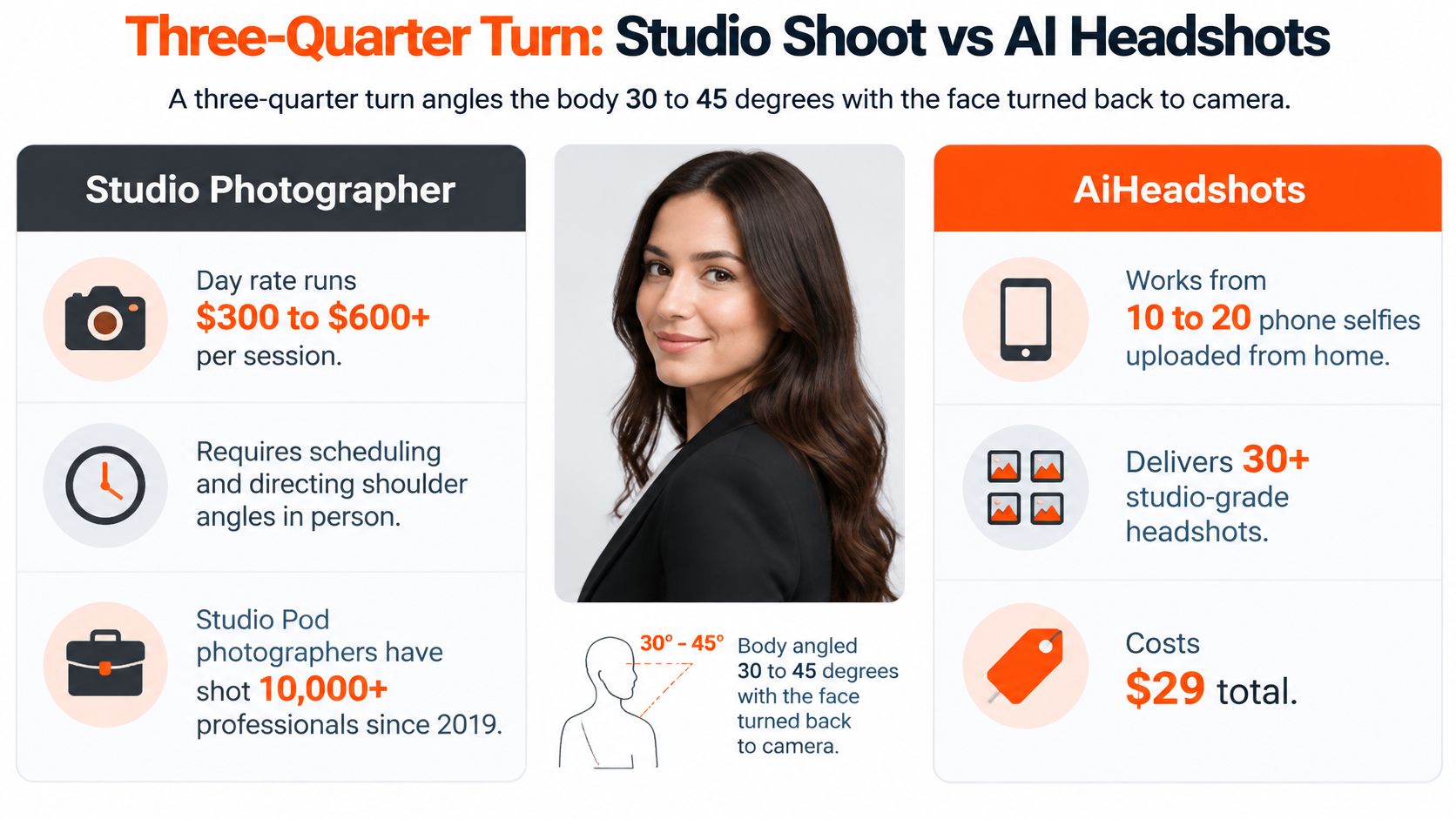
You'll see it on consulting and advisory firm bios, and on LinkedIn photos for sales and business development roles. Keep the chin level, keep your eyes on the glass, and if you're shooting selfies for an automated studio, include a few angled frames so the output matches the pose you want.
Watch the shoulder-first sequence in motion:
2. Square-on with direct eye contact
Body facing the camera, shoulders level, head centered. This is the most direct pose in the set, and it signals transparency. Law, finance and medicine live here, because credibility is the entire read.
The eye contact is doing measurable work. A Springer-published study on professional personal branding found that smiling and looking directly into the camera positively affected viewers' perceptions of credibility, based on interviews with 11 recruitment professionals (Springer study on professional personal branding). The sample is small, so treat it as direction rather than a universal percentage, but the direction is unambiguous: visible eyes and camera engagement move the credibility read.
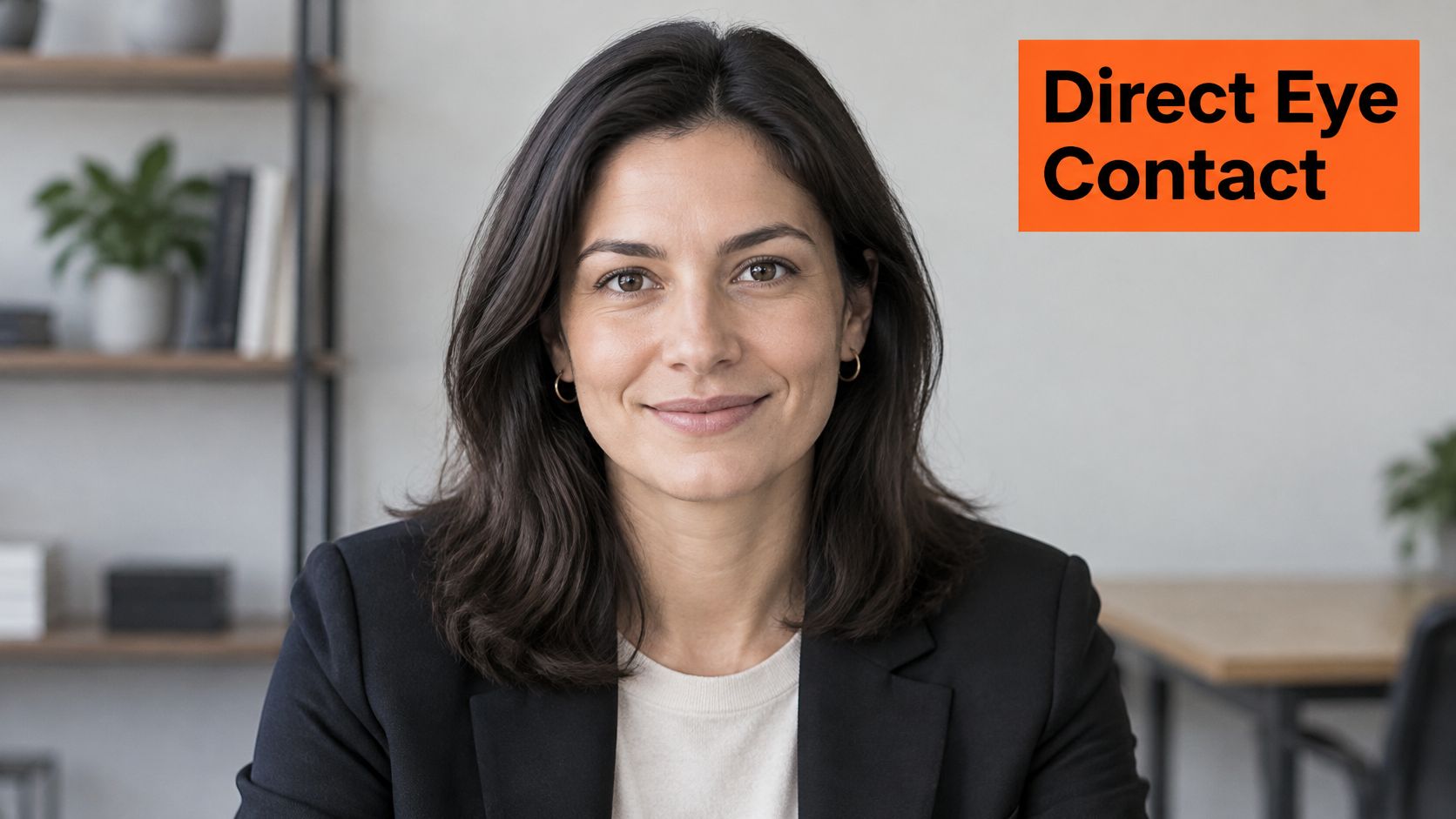
Use it for partner and attorney headshots on professional services sites, and for standardized team pages across HR and operations groups.
Three fixes make it work. Drop the shoulders and let the arms hang naturally. Lift the chin slightly to lengthen the neck without jutting it forward. Look at a point just above the lens so the stare doesn't go glassy. Our guide to happy facial expressions in professional headshots covers how much smile to pair with a straight-on frame.
3. Slight head tilt
Head tilted 5 to 10 degrees to one side while the body stays square or near-square. The tilt softens the frame and reads as approachable, which is why therapists, counselors and realtors lean on it. Small angles work. Past 10 degrees the pose looks deliberate and pulls attention off the face.
Warmth is measurable. Snappr's professional headshot guidance cites research showing people form judgments from faces in about one-tenth of a second, and notes that visible-teeth smiles produced the strongest likability improvement in an analysis of more than 60,000 professional-photo ratings, an average 1.35-point lift.
Studio rule: the tilt is a warmth dial. Turn it and you trade authority for approachability, which is right for a therapy practice and wrong for a courtroom.
Tilt from the neck, not the shoulders. Keep the eyes level with the lens, and pair the angle with a relaxed mouth rather than a wide grin. Solo shooters can work through the full sequence in our walkthrough on how to pose for a professional headshot.
4. Arms crossed
Arms folded across the chest, body square or angled. The pose projects confidence and experience, and it works for leaders who want to look settled in their authority. Execution decides the read: tense arms look defensive, relaxed forearms look composed.
Expression outranks the gesture. A controlled study of professional-profile poses found smiling faces were judged more competent than neutral faces, and a hand-on-chin "thinking" pose drew the lowest competence ratings from software-specialist evaluators. The gap between neutral and thinking faces was statistically significant at Cohen's d = 0.615, p < .001, and smiling versus thinking was larger at d = 0.888, p < .001, as reported in the Australian Journal of Psychology.
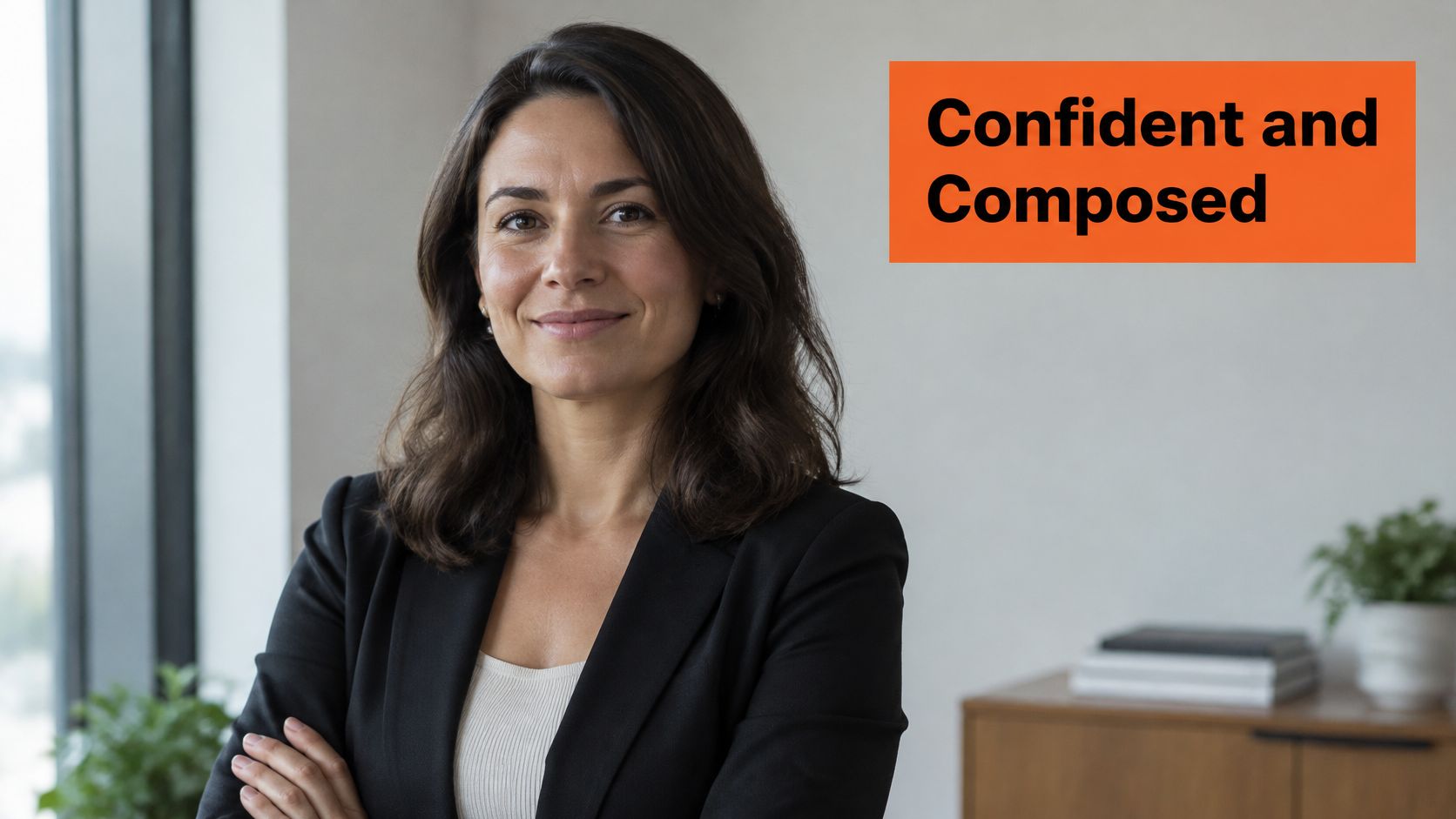
The practical translation: let the forearms rest instead of clenching the hands, drop the shoulders before the shutter, and crop at mid-chest so the crossed arms read as intentional rather than accidental. Use it for senior consultant and advisor bios, and for executive headshots in operations and finance leadership.
5. Seated at a desk with a forward lean
Sit at a desk or table and lean forward slightly from the hips. The lean reads as engagement, like someone ready to get to work, and the desk says something about the role for operations, engineering and product people. A lean that starts in the lower back instead of the hips pulls the frame down and reads as a slump.
Aftershoot's corporate portrait guidance describes the underlying alignment: a straight back, shoulders drawn gently back and down, and a slight forward lean from the hips or upper body, with weight shifts onto the back foot creating natural asymmetry without a dramatic pose.
Three things to control:
- Sit tall first, then lean. Stack the spine before you move a single inch.
- Lock the desk height. On a team shoot, the desk edge sits at the same height for every person.
- Recheck the crop. Shoulders stay inside the frame, and no monitor glare behind the head.

You'll see this pose on product and engineering leads on company About pages, and on operations managers shown at their desks in team directories. Our post on posing for corporate headshots breaks down the seated setup frame by frame.
6. Hands clasped in frame
Hands folded or clasped at the lower edge of the frame, usually at mid-chest or waist level. The pose gives the upper body a stable anchor and reads calm and professional. It earns its keep in mid-chest crops where the hands stay sharp and in proportion. Oversized or awkwardly placed hands are the most common flaw in this pose, and they're almost always a camera-height problem rather than a hand problem.
While the hands work below, the chin works above. Photographers commonly direct subjects to push the chin slightly forward and tilt it down rather than lowering the head, which separates the jawline from the neck and stops the camera from seeing up into the nostrils, per Metroplex Headshots. The movement is subtle. Push it too far and the expression closes over.
Hold the hands loosely enough that no knuckles go white, and keep one hand over the other so the shape reads as balanced instead of tangled.
Use it for physician and dentist profiles on practice websites, and for advisory or accounting partner bios. Crop at mid-chest and the hands sit fully in frame, doing exactly the job they're there for.
7. Leaning against a surface
One shoulder against a wall, doorframe or desk edge while the body stays relaxed. The read is approachable and self-assured, which suits consultants and creatives who want a little personality without losing polish.
The expression carries this pose. Corporate portrait guidance describes the target as neither overly serious, which can imply concern, nor overly flippant, and notes that a direct gaze often works better than an elaborate expression. Slight lower-eyelid engagement, sometimes called a squinch, makes the eyes look more focused without forcing a broad grin, per PhotographyTalk's corporate headshot guide.
If the surface has a poster, a light switch or a plant in the crop, move two feet. The wall is a prop, not a set.
Shift your weight onto one hip and let the shoulders drop. Don't lean so far that the head falls below the shoulder line, because that angle reads as slouching no matter how good the light is. Use it for consultant headshots on boutique advisory sites, and for marketing or design lead profiles on agency pages.
8. Standing crop with negative space
A standing head-and-shoulders crop with clear space around the head. The composition leaves room for web layouts, slide decks and team grids, which makes it the practical choice for HR and marketing teams managing company-wide standards. Consistent framing across a team page matters as much as the individual pose.
Getting the crop to survive a thumbnail
Profile photos get seen small, often without any context around them. Guidance on profile imagery flags outdated, filtered, cropped or unauthentic photos as recurring problems, and puts weight on an image that resembles the person, including testing it at thumbnail size, per Knowledge Enthusiast's LinkedIn profile picture guide. A pose that reads beautifully at full size can turn into a featureless blob at 60 pixels wide.
- One camera height for everyone. Same distance, same height, same lens across the whole team.
- Leave headroom. Roughly the width of the eyes above the top of the head.
- Match the direction. If half your selfies are angled left and half right, the finished set will look split.
Use it for company-wide team pages at small and mid-sized businesses, and for speaker or panelist grids on conference sites where the crop has to survive a small grid tile.
Eight corporate headshot poses at a glance
| Pose | Body angle | Best for | Difficulty to self-direct | Industry fit |
|---|---|---|---|---|
| Three-quarter turn | Shoulders turned 30–45°; face toward camera | Adding dimension and a confident, current look | Harder; shoulder angle takes practice | Broad fit, from finance to design |
| Square-on with direct eye contact | Shoulders parallel to camera; head centered | Directness, credibility, and consistent team photos | Easy to reproduce; relax shoulders and jaw | Law, finance, medicine, HR, and operations |
| Slight head tilt | Body square or near-square; head tilted 5–10° | A warm, approachable impression | Moderate; keep the tilt subtle | Therapy, real estate, and coaching |
| Arms crossed | Body square or angled; forearms folded | Showing confidence and experience | Moderate; keep arms and shoulders relaxed | Consulting, executive leadership, and advisory |
| Seated at a desk with a forward lean | Seated, leaning slightly forward from the hips | Showing engagement and workplace context | Moderate; avoid slouching and check the crop | Product, engineering, and operations |
| Hands clasped in frame | Usually square or near-square; hands visible at waist or chest | A calm, professional look | Moderate; keep hands relaxed and well framed | Medical, legal, accounting, and advisory |
| Leaning against a surface | Relaxed stance with one shoulder or hip against a surface | A polished look with added personality | Moderate; needs a simple surface and controlled stance | Marketing, design, and consulting |
| Standing crop with negative space | Standing, head-and-shoulders framing with space around the head | Consistent team photos and flexible layouts | Easy with consistent camera setup | HR, company teams, and conference speakers |
Pick one pose, then shoot it
One pose executed well beats eight executed halfway. Start with the three-quarter turn: it flatters nearly every face and needs no special setup. Go square-on for law, finance and medicine, where a straight read of the eyes carries the credibility. Add a tilt only when warmth is part of the job, and keep it under 10 degrees.
For team pages, the pose is a standard rather than a preference. Pick one angle, one chin cue and one crop, brief everyone the same way, and the page stops looking like eight different companies. Consistent cropping, whether waist-up or shoulders-up, does the rest.
Any of these reads cleanly on a phone in a room with decent window light. AiHeadshots takes that raw material and finishes it: upload 10 to 20 casual selfies, pick your styles, and get 30+ headshots in about 30 minutes. The Professional plan runs $39 for 50 finished headshots across 5 unique style looks, enough range to find the frame that reads right for the role.
The pose guidance above reflects patterns observed across automated studio sessions powered by Studio Pod technology, rather than a recycled listicle. Upload your selfies, pick your look, and start a pack at AiHeadshots to land the pose that matches the job you're after.