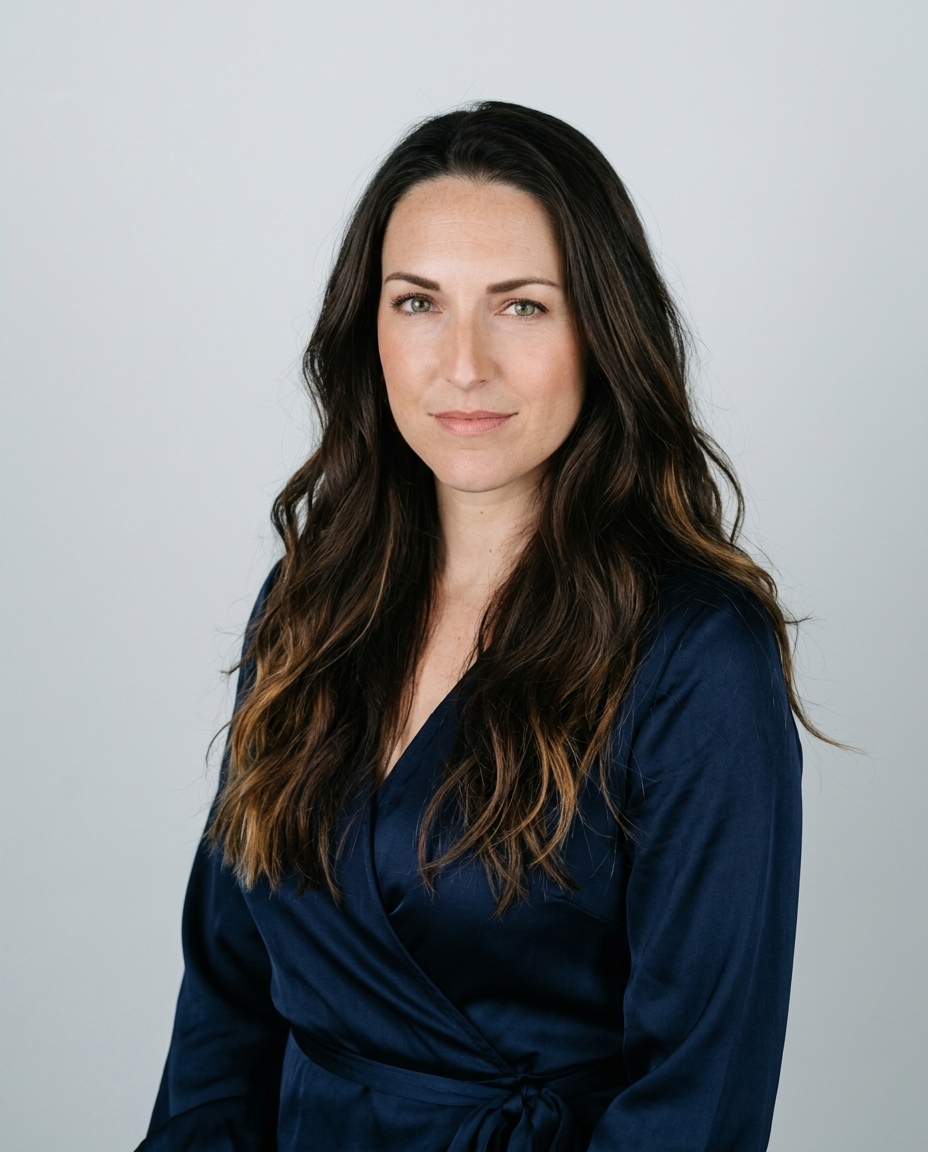
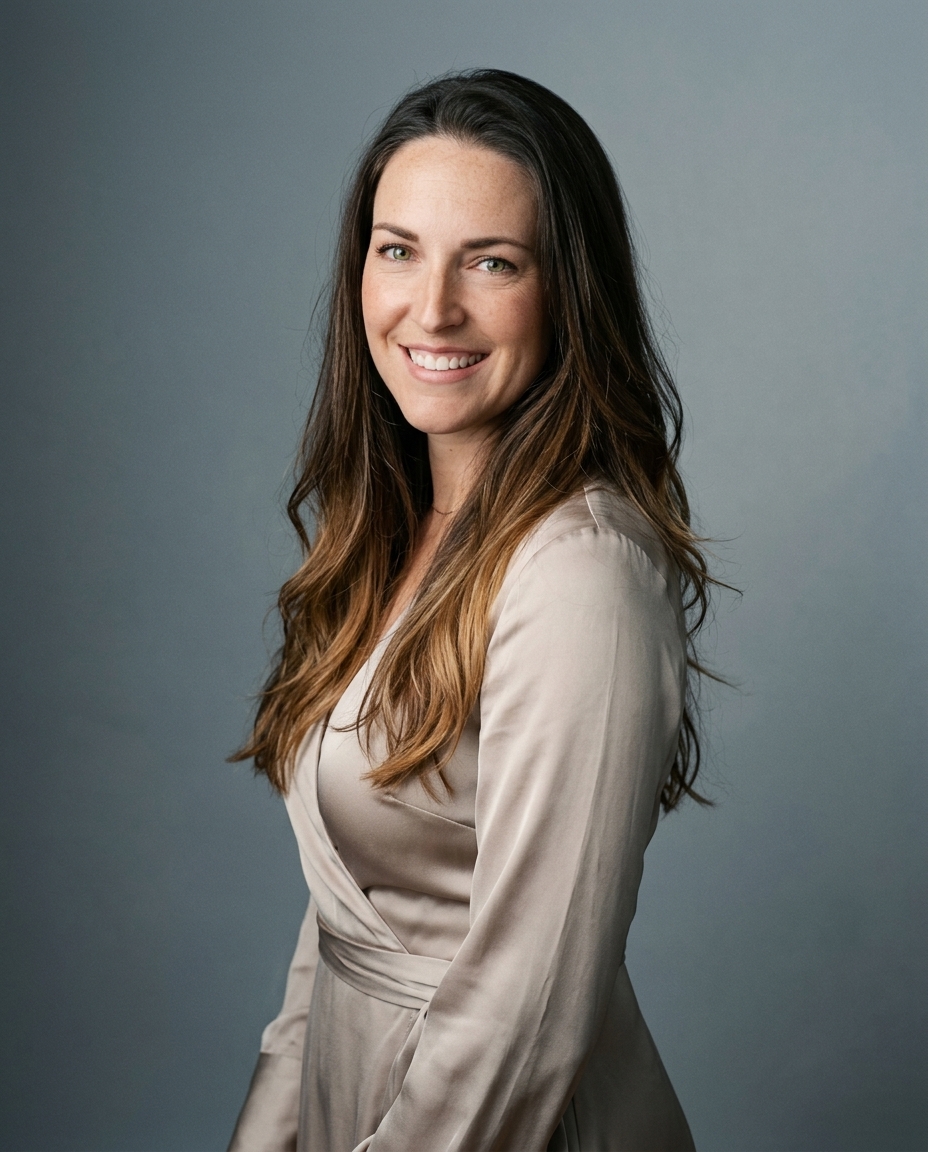

The strongest business headshots for women are rarely the most glamorous. They're the most credible. That matters because LinkedIn has reported that profiles with a professional photo can receive up to 21 times more profile views and up to 36 times more messages than profiles without one, as noted in this overview of why professional photos matter.
We've seen the same pattern from the photography side. At Studio Pod, we've photographed 10,000+ real professionals since 2019, and the headshots that work aren't the stiff corporate portraits people used to tolerate. They're current, well-lit, intentional, and aligned with the job the image needs to do. That's the standard now for business headshots women choose to use across LinkedIn, company sites, speaker pages, and email signatures.
Table of Contents
- The new rules for a professional headshot
- Planning your look and wardrobe
- Posing and expression that builds trust
- Why lighting and backgrounds are not minor details
- Choosing your path for photographer vs AI headshots
- From retouching to final delivery
The new rules for a professional headshot
A business headshot isn't a formality anymore. It's your first pass at trust.
That shift changed the look of a good portrait. The old formula was rigid posture, flat expression, and a generic studio backdrop. The modern version still looks polished, but it doesn't look generic. It looks like a competent person on a good day.
Practical rule: If the photo feels more “corporate photo day” than “credible professional,” it's already dated.
Women in business often get especially poor advice here. Too much of it focuses on appearance in the abstract instead of context. A better standard is simpler. Your photo should match the level of authority, warmth, and clarity your role requires. A founder, attorney, physician, consultant, recruiter, and sales leader shouldn't all use the same visual signals.
We also see a clear difference between photos made for ego and photos made for use. A useful headshot reads well at small sizes, survives a crop, and still looks natural on a company bio page. If you want a good example of a photographer-led approach to that kind of image design, this breakdown of a unique editorial headshot process is worth reviewing.
What changed
Digital platforms trained people to make decisions fast. They scan your image before they read your headline or credentials. That doesn't mean beauty wins. It means signals win. Fit. Expression. Lighting. Styling. Recency.
A modern headshot should look prepared, not overproduced.
That's the update. The best business headshots women use in 2026 don't chase perfection. They show judgment.
Planning your look and wardrobe
Most wardrobe mistakes happen before anyone gets in front of a camera. The problem isn't that the outfit is bad. It's that the outfit doesn't match the job of the image.

Start with the job of the image
For women's business headshots, the strongest workflow is to decide the final use first, then align wardrobe, background, and styling to that use. Guidance from this female professional headshot planning resource recommends defining the goal before the session and keeping hair and makeup close to everyday professional styling so the image reads polished but authentic.
That's the right order. Not outfit first. Use first.
A LinkedIn headshot for a corporate executive usually needs restraint. A consultant's site bio can take a bit more personality. A healthcare profile often needs more warmth and less severity. Once that use is clear, clothing decisions get easier.
For readers who want a broader style reference outside photography, this Vivien Lauren business fashion advice is a useful companion on how clothing choices read in professional settings.
What usually works on camera
On camera, simple beats busy. Structure beats drape. Fit beats trend.
A few practical patterns hold up across industries:
- Choose polished basics: Solid colors usually outperform loud prints. Blazers, structured tops, and clean necklines frame the face well. Minimal jewelry keeps attention where it belongs. If you want more specific outfit combinations, our guide to executive headshot wardrobe goes deeper.
Clothing should look like your real professional self, just tightened up one notch. If you never wear a sharp-shouldered blazer to work, don't make your headshot the one place you pretend you do. Viewers notice that mismatch even if they can't explain it.
Hair and makeup should follow the same rule. Keep them close to your normal standard, but cleaner and more camera-aware. That means controlling flyaways, reducing shine, and making sure features don't disappear under lighting. It doesn't mean transforming your face into someone else's.
Your best headshot outfit is usually the one you'd wear to an important meeting with better fabric, better fit, and fewer distractions.
Posing and expression that builds trust
Individuals don't need help “posing.” They need help stopping the visible effort of posing.

The strongest expression isn't a default smile. It's the expression that fits the role. One professional guide on headshots for women and expression choices makes that point clearly. There's no single right expression. It recommends squared shoulders with a neutral or slight smile for authority roles, and a slight body angle with a genuine smile for client-facing roles.
Authority and warmth are different signals
Many business headshots women receive often go off course. People try to split the difference and end up with a vague expression that says nothing.
If your role depends on judgment, leadership, or authority, face the camera more directly. Keep your shoulders squared. Relax your mouth. Don't force intensity. Calm reads stronger than stern.
If your role depends on connection, referral trust, or client ease, soften the angle. Turn the body slightly. Let the smile reach the eyes. The change should be small. A little angle creates life in the frame.
Field note: Credibility and approachability aren't opposites. They're proportions.
How to stop looking posed
A natural headshot usually comes from movement and micro-adjustment, not from holding still and hoping for the best.
Three fixes work repeatedly in studio sessions:
- Reset your jaw and exhale before the shutter.
- Bring your forehead slightly forward instead of pulling your chin up.
- Rotate your torso a little, then bring your eyes back to camera.
Those changes are subtle, but they remove stiffness fast. We've also written about this pattern in our 10,000 headshots study, where relaxed expressions consistently read better than forced ones.
A short demonstration helps more than static advice. This walkthrough shows the kind of small adjustments that improve expression and posture without making the image feel staged.
Why lighting and backgrounds are not minor details
People often blame themselves for a weak headshot when the actual problem is technical. Lighting and background choices control far more of the final impression than most clients expect.

Light changes the read of your face
In a headshot A/B test cited for company portraits, a new professional headshot produced an average 75.93% improvement in perceived competence and as much as a 115.5% swing in viewer competence perception, according to this analysis of modern professional headshot lighting and perception.
That result tracks with what photographers already know. Frontal lighting tends to feel open, clean, and competent because it reduces harsh shadows. Rembrandt-style lighting adds depth and seriousness because it shapes the face more aggressively. Neither is automatically better. The right choice depends on what the image needs to communicate.
Backgrounds should support, not compete
Backgrounds should carry the same discipline. If they're distracting, they pull authority away from the face. If they're too generic, they flatten the image.
A neutral studio background remains the safest option for versatility. It works across LinkedIn, company directories, media kits, and speaking bios. Environmental backgrounds work when the setting adds meaning without stealing focus.
If you're still trying to make a phone snapshot do the job of a controlled portrait, read our breakdown of why a phone camera isn't enough. The issue usually isn't resolution. It's uncontrolled light, lens distortion, and inconsistent backgrounds.
Good headshots don't happen because the camera is expensive. They happen because the scene is controlled.
Choosing your path for photographer vs AI headshots
There are three real options. Hire a photographer. Use an AI headshot tool. Or do it yourself with a phone.
Each has a place. Each has obvious trade-offs.
What each option is actually good at
One independent guide estimates traditional professional headshot sessions at $400–$1,200 with 2–5 retouched images delivered in 2–4 weeks, while AI headshot generators are described as producing 40–200+ images in under 1 hour at roughly $29–$75, as summarized in this female professional headshot cost and turnaround guide.
That comparison is useful, but the decision isn't just price. It's about what kind of control you need.
| Attribute | Traditional Photographer | AiHeadshots | DIY (Phone Selfie) |
|---|---|---|---|
| Direction during capture | High. A photographer coaches pose, expression, and angle in real time. | None during capture. You upload input photos and the system generates options. | None unless a friend helps. |
| Turnaround | Slower. Often tied to scheduling and editing queue. | Fast. 30+ studio-grade headshots delivered in ~30 minutes from 10–20 phone selfies. | Immediate capture, but usually slow to get right. |
| Cost | Higher upfront session cost. | Basic $29 / Professional $39 / Executive $59 / Teams at $22-29 per seat for 10+ seats. | Lowest direct cost. |
| Best use case | Personal branding shoots, executive campaigns, custom art direction. | Fast professional updates, team consistency, LinkedIn, company bios, speaker pages. | Casual internal use only. |
| Typical weakness | Time and scheduling friction. | Output quality depends on the quality and variety of uploads. | Weak lighting, bad perspective, and inconsistent styling. |
We built AiHeadshots from a photography background, not as a generic software experiment. Studio Pod's founders, Joseph West and Hunter Casner, built it after photographing thousands of real professionals in Houston. That matters because the standard isn't “AI-looking.” It's studio-looking.
We don't treat AI as a replacement for every session. A traditional photographer still wins for high-touch branding work, custom sets, and hands-on art direction. But if you need a clean professional image fast, without a studio visit, AI is the practical option. Our direct comparison at AI headshots vs photographer breaks that trade-off down further.
Competitors like HeadshotPro, BetterPic, Aragon, Secta, and ProPhotos all sit in the same broad category of AI-generated professional headshots. The meaningful differences are workflow, photographer heritage, speed, and price. Our position is simple. We're photographers who built the system, and we price entry at $29.
From retouching to final delivery
Retouching should clean up noise, not rewrite your face.
Retouch lightly and deploy consistently
The best retouching removes temporary distractions. Stray hairs. A blemish. Uneven skin shine. Minor under-eye darkness. It doesn't change your bone structure, narrow your face, or smooth everything into plastic. If a colleague meets you after seeing your headshot and thinks, “That doesn't look like her,” the edit failed.
After selection, use the same visual standard everywhere. Put the chosen image on LinkedIn, your company profile, speaker bios, press features, and email signature. Consistency makes you easier to recognize and presents a cleaner professional identity.
There's another practical issue people ignore. Headshots age. One independent guide advises updating a headshot every 1–2 years or when your appearance changes significantly, as noted in that earlier cost-and-turnaround reference. That's a useful benchmark because your image isn't a one-time asset anymore. It's ongoing professional maintenance.
For teams, consistency matters even more. Mixed crops, mixed lighting, and mixed quality make a company page look disorganized fast. For individuals, the problem is usually the opposite. They keep an outdated image far too long because replacing it feels expensive or inconvenient.
If you want a fast refresh without scheduling a studio session, compare plans on AiHeadshots pricing.
Upload 10 selfies, see your first headshot in 30 minutes, for $29 with AiHeadshots.