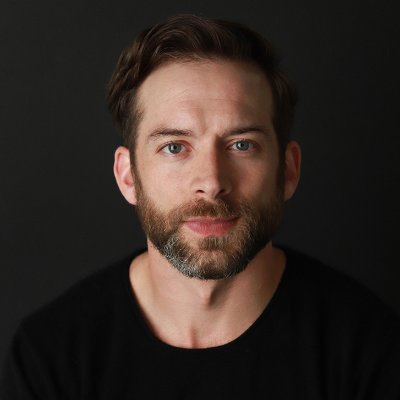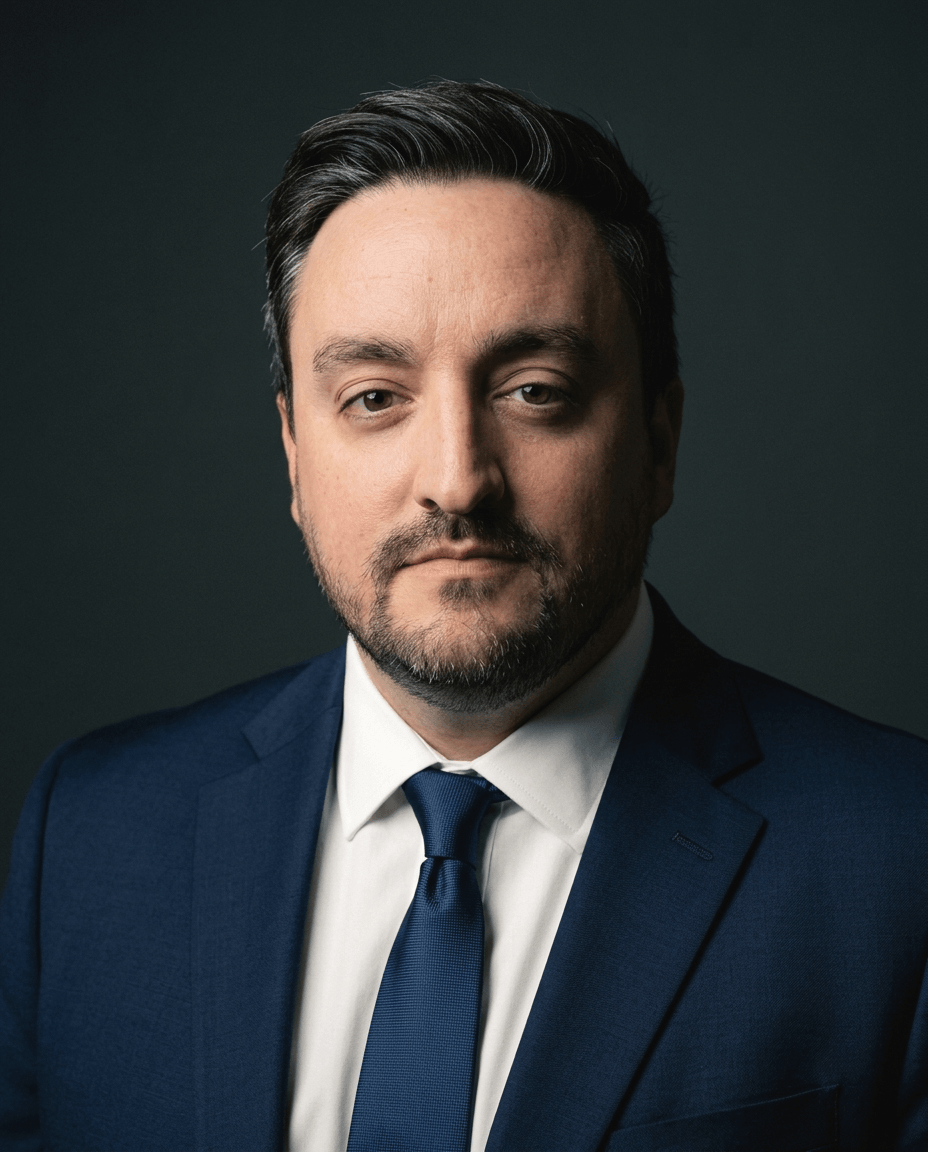
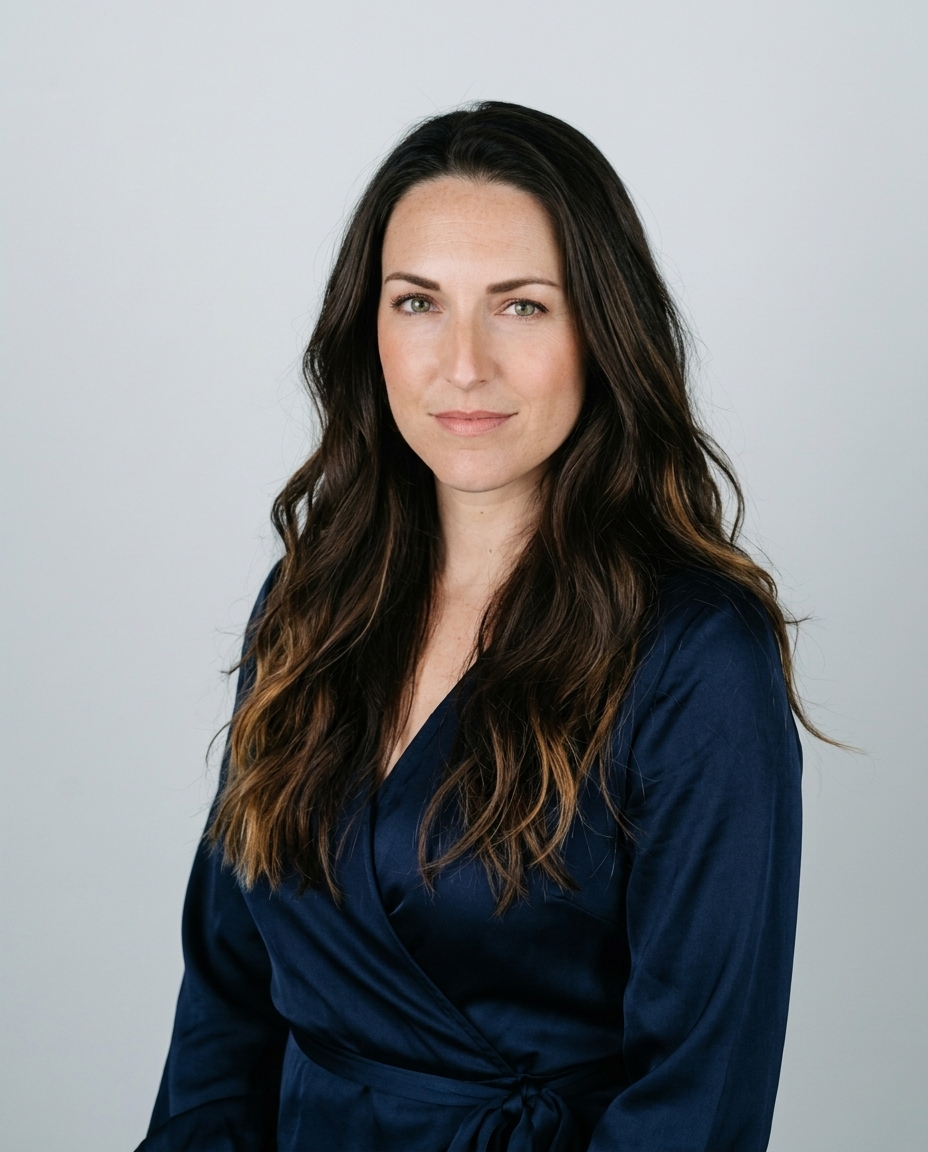
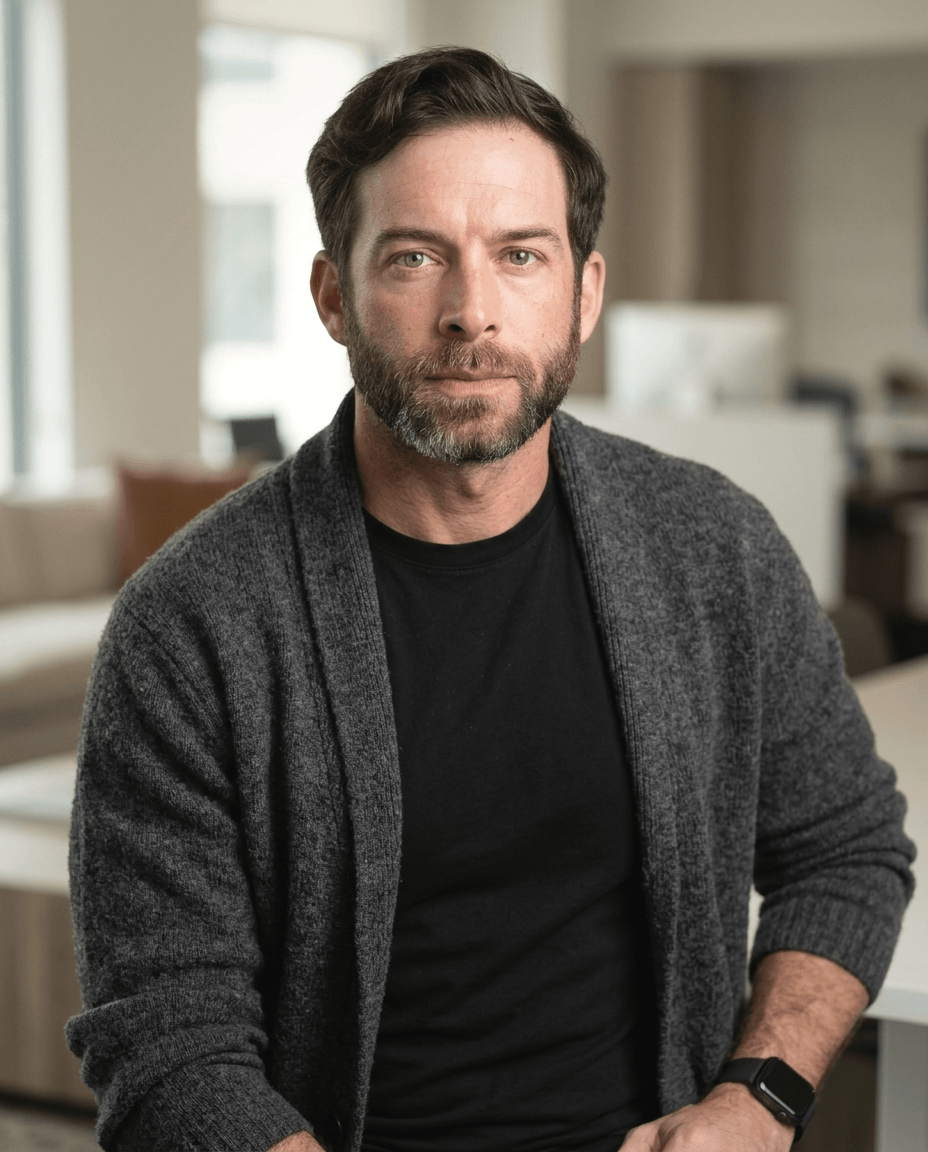
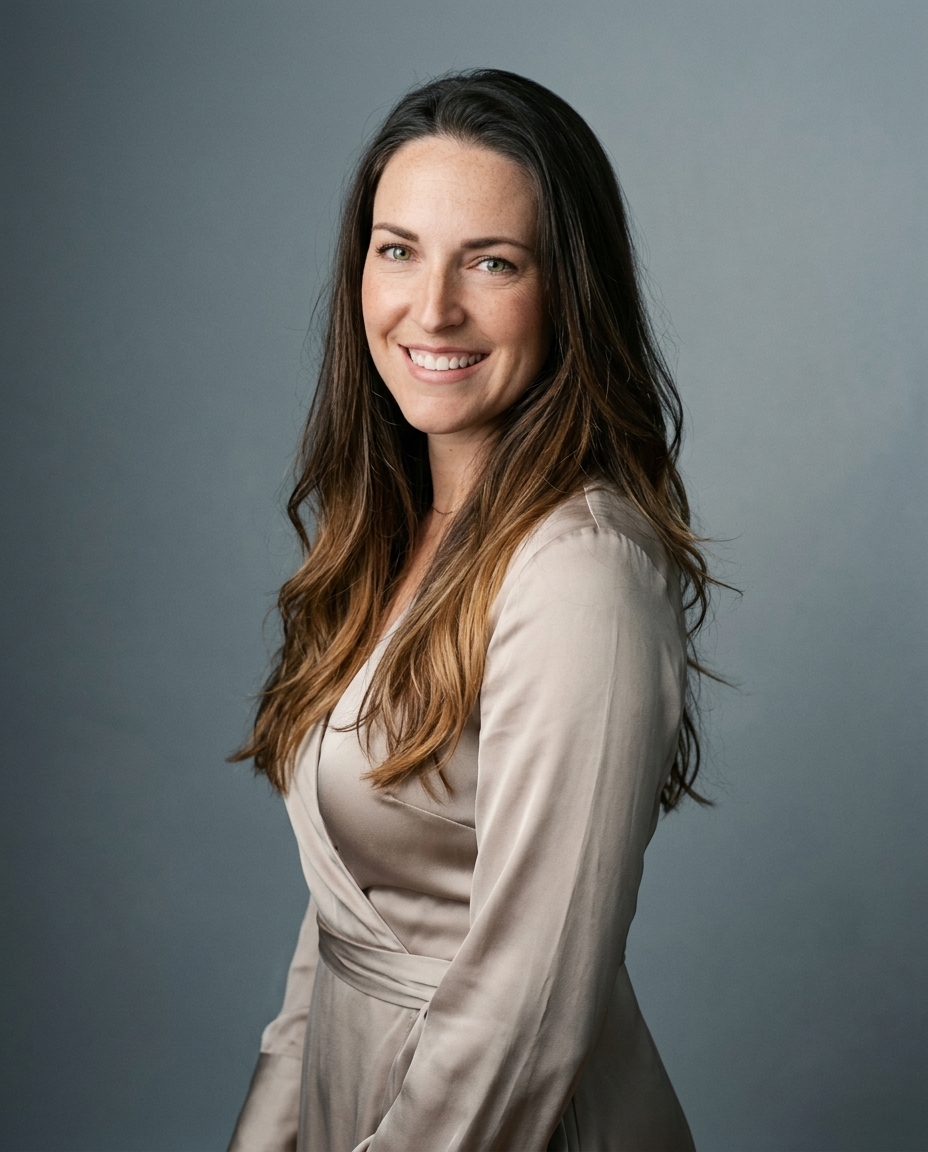
The strongest headshot acting examples match lighting, framing, and expression to a specific casting lane, and you need at least two usable images, one commercial and one theatrical, with three to five distinct looks for broader coverage. The seven examples below span commercial, character, theatrical, editorial, and versatile submissions, each built to send one clear signal at thumbnail size.
A great acting headshot makes a casting decision. Casting teams scan small images fast, so every choice in light, crop, wardrobe, and expression either clarifies your lane or blurs it. One universal look can't do both jobs. You need a small set that shows range without sending conflicting signals, a principle covered in this guide to evaluating commercial images.
We're photographers first. Studio Pod, our automated headshot studio in Houston, was founded by photographers Joseph West and Chris Bailey and has shot 10,000+ real professionals since 2019. That field work informs AiHeadshots. We built an AI from a photography practice, not the other way around.
Table of Contents
- 1. Neutral backdrop commercial headshot
- 2. Rembrandt lighting character headshot
- 3. High-contrast black-and-white headshot
- 4. Three-quarter turn headshot
- 5. Natural window-light headshot
- 6. Multi-look comp card
- 7. Direct-gaze, closed-mouth hero headshot
- 7 Headshot Acting Examples Compared
- Build one set that shows range without losing clarity
1. Neutral backdrop commercial headshot
Start here. A plain grey, white, or soft blue background, a soft key light placed about 45 degrees to the side, and eyes locked on the lens puts the face first. That's the standard submission photo for commercial and print casting, and it follows the plain backdrop portraiture tradition of Irving Penn's studio work.
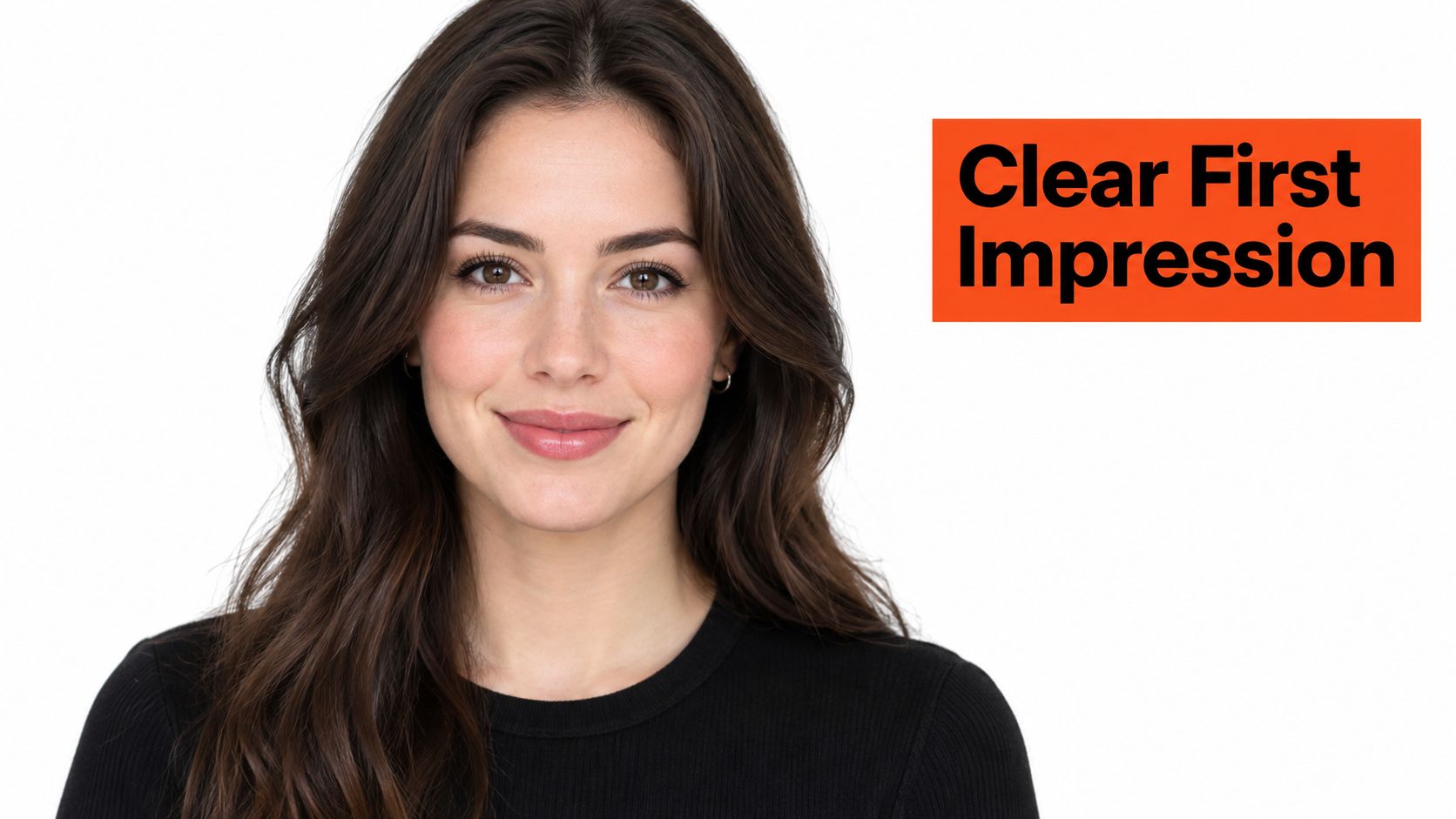
This format exists for operational reasons, not decoration. Actor headshots have historically functioned as a standardized professional identifier alongside an acting résumé, and the SAG-AFTRA handbook guidance on standard headshot format identifies the 8-by-10-inch vertical, full-frame image as the standard. The same guidance notes color headshots are now necessary because casting is increasingly conducted through the internet. Your image has to work in print and on screen.
How to get it right
Wear solid colors that contrast with the backdrop. Keep the frame tight enough that the face fills at least half the image, because casting teams judge legibility in thumbnail views. Our breakdown of best lighting setups for portrait headshots covers key placement in detail.
Practical rule: If the eyes don't read clearly when you shrink the image to a postage stamp, the crop is too loose.
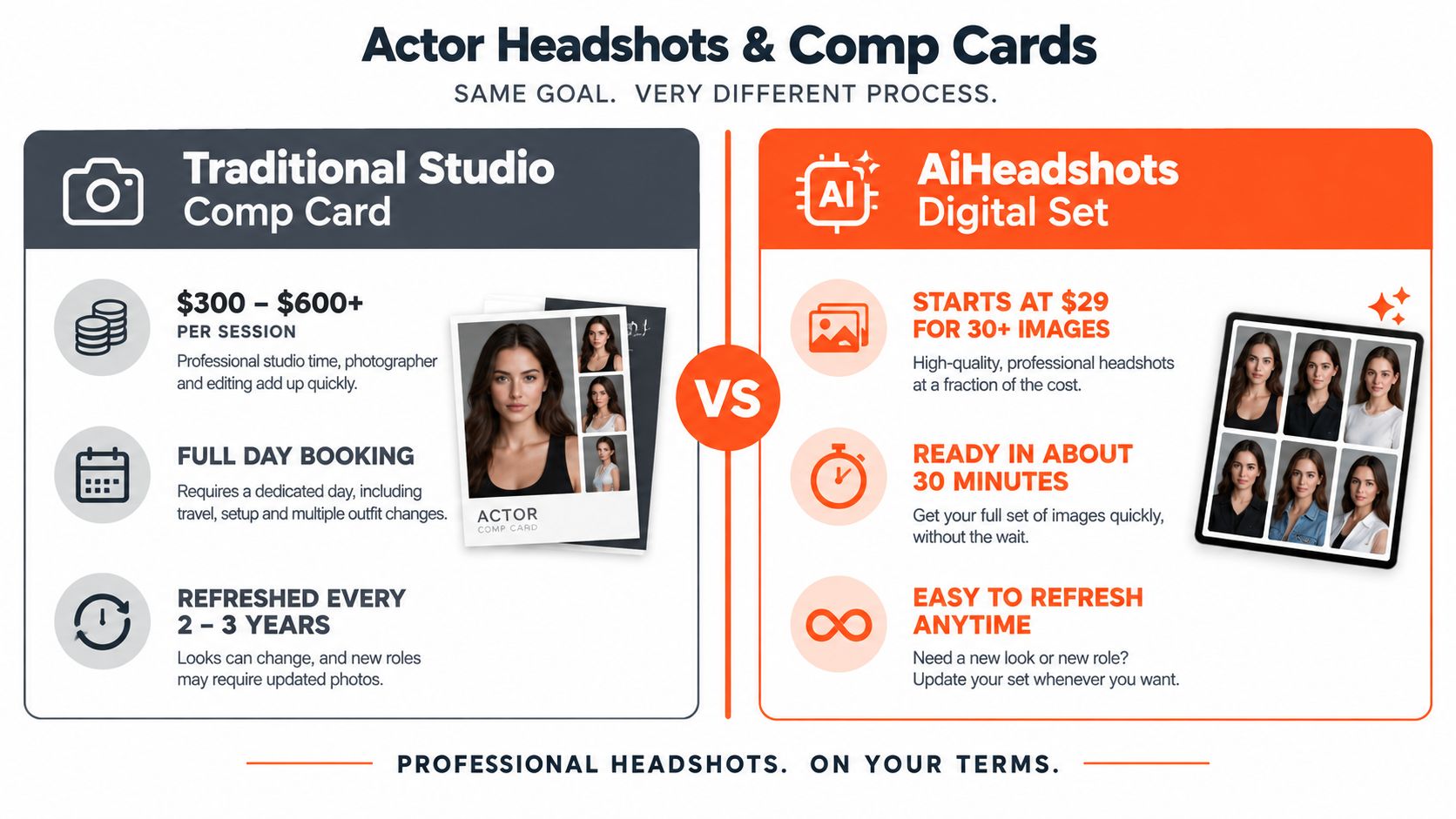
Cost is the honest trade-off. A traditional photographer day runs $300 to $600+ before retouching. AiHeadshots starts at $29 for 30+ studio-grade headshots in about 30 minutes, drawing on the studio approach Studio Pod has used across 10,000+ real sessions since 2019.
2. Rembrandt lighting character headshot
Rembrandt lighting places a small triangle of light on the shadow-side cheek. For actors, that shadow signals character. A detective, a rival, a figure with a history. It doesn't signal approachable, and you shouldn't ask it to.
Yousuf Karsh used strong directional light to sculpt his subjects, most famously in his 1941 portrait of Winston Churchill, where the shadow falloff carries as much weight as the face itself. Character headshots submitted for thriller and crime casting borrow directly from that logic. The light tells the casting team what kind of scene you're built for before they read a credit.
The scale of competition makes that signal matter. Casting director Bonnie Gillespie described maintaining physical cubbies with 330 actors she had cast, 808 actors whose work she considered especially strong, and 2,201 actors whose work she knew, plus approximately 4,700 headshots of actors she didn't yet know, as documented in this account of casting office headshot files. That's more than 8,000 actor images with one professional. A generic lit face disappears in that volume.
Watch the shadow side work in practice before you commit to this style.
Use this style when the role calls for intensity, not as a general purpose headshot. Keep a second, neutral lit headshot in your set for broader casting, and check the shadow side on a phone screen before you commit. Our actor headshot tips for matching looks to roles cover when to lead with character and when to hold it back.
3. High-contrast black-and-white headshot
Black and white removes color as a variable. The viewer goes straight to texture, expression, and bone structure. Richard Avedon built much of his reputation on stark, high contrast portraits against plain backgrounds, including the American West series shot between 1979 and 1984.
For actors, a monochrome headshot reads as deliberate and editorial. It holds attention in a stack of color submissions and works well in theater program bios and fine art portrait series. It also carries a real risk, and we'll be direct about it. Color has replaced black and white as the casting standard for practical reasons.
The trade-off you accept
The SAG-AFTRA handbook explains that color headshots are now necessary because casting is increasingly conducted through the internet, a point covered in the overview of current actor headshot standards. A casting team can't judge hair color or eye color from a monochrome file. That can cost you a submission before anyone looks at your expression.
A monochrome image is a supporting look, never your only look. Treat it as an editorial statement, not your primary identification photo.
Ask casting directors whether they accept monochrome before sending. Convert from a color file with a strong red channel, which brings out skin tone detail, and keep a color version on hand for commercial auditions. Used that way, black and white adds range. Used as your main image, it creates friction in a system built for color.
4. Three-quarter turn headshot
A three-quarter turn rotates the head 30 to 45 degrees away from the camera while the eyes stay toward the lens. The jaw, cheekbone, and brow line become the subject. Film and television casting often asks for this angle because it shows structure a straight-on frontal shot can hide.
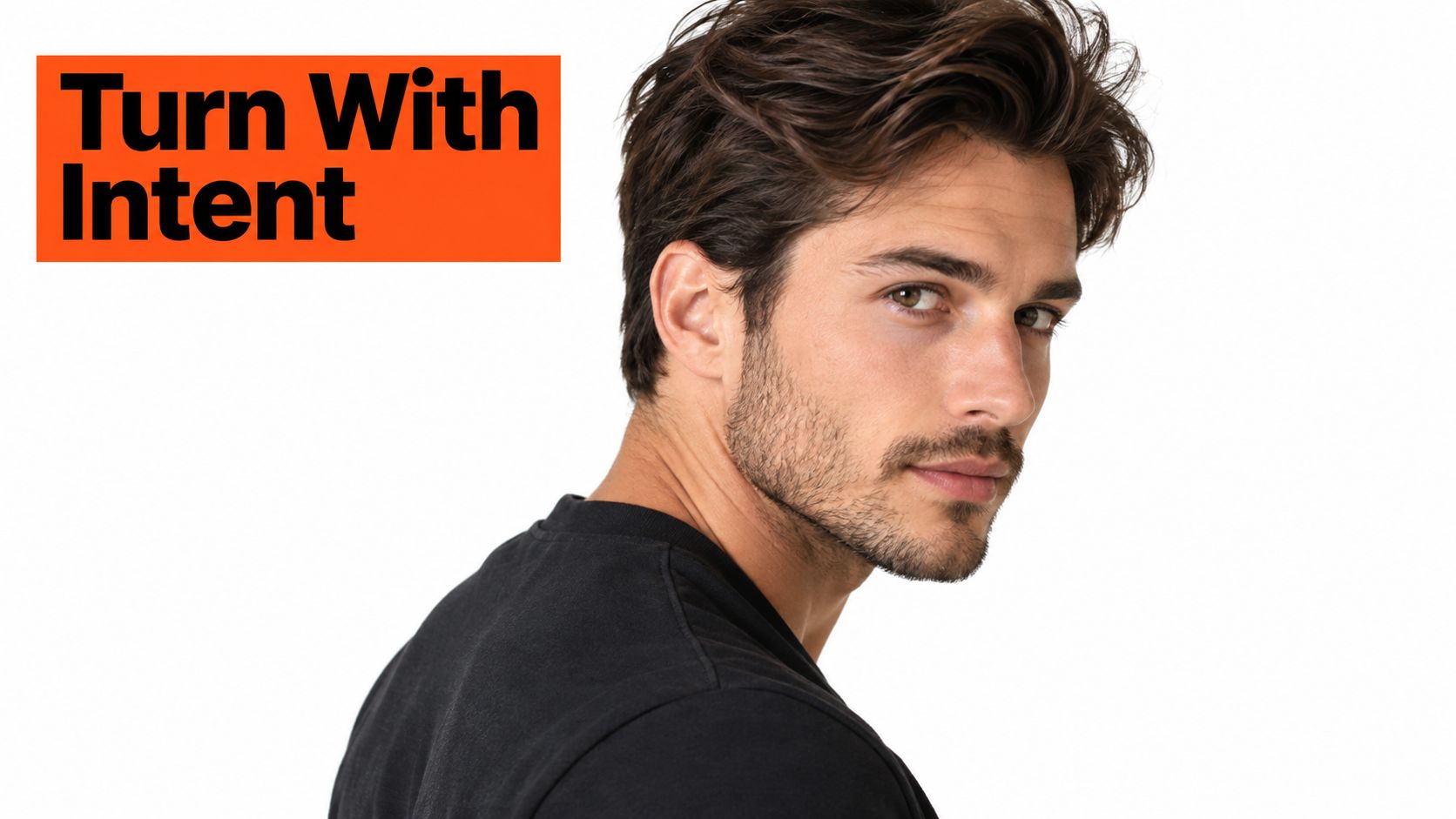
It reads as more cinematic than a direct to camera portrait without losing connection. Supporting role headshots submitted for film and series casting use it often, and profile-adjacent portraits in fashion and editorial photography rely on the same geometry.
There is a limit, and it's a real one. SAG-AFTRA's Young Performers Handbook specifies a vertical, full-frame 8-by-10-inch color photograph for printed submissions and rules out full-length, three-quarter, and profile images, as stated in the SAG-AFTRA Young Performers Handbook submission standards. Read that carefully. The handbook concerns body framing. A head turned three-quarter within a tight chest-up crop is different from a three-quarter body shot, but you must confirm what a given submission accepts.
Technique notes
Turn the body first, then the head, to avoid a stiff neck line. Keep the eyes on the lens even when the head turns away. Our guide to actor headshot poses and angles breaks down the turn in detail.
Use this as a second headshot, not your primary image. It proves dimension. Your anchor shot proves identity.
5. Natural window-light headshot
Window light is soft, directional, and warm, and it reads as real. The look suits everyday characters, lifestyle commercials for consumer brands, and television roles that need an approachable face. Everyday character headshots submitted for television comedy and drama use this light because it feels like a person, not a production.
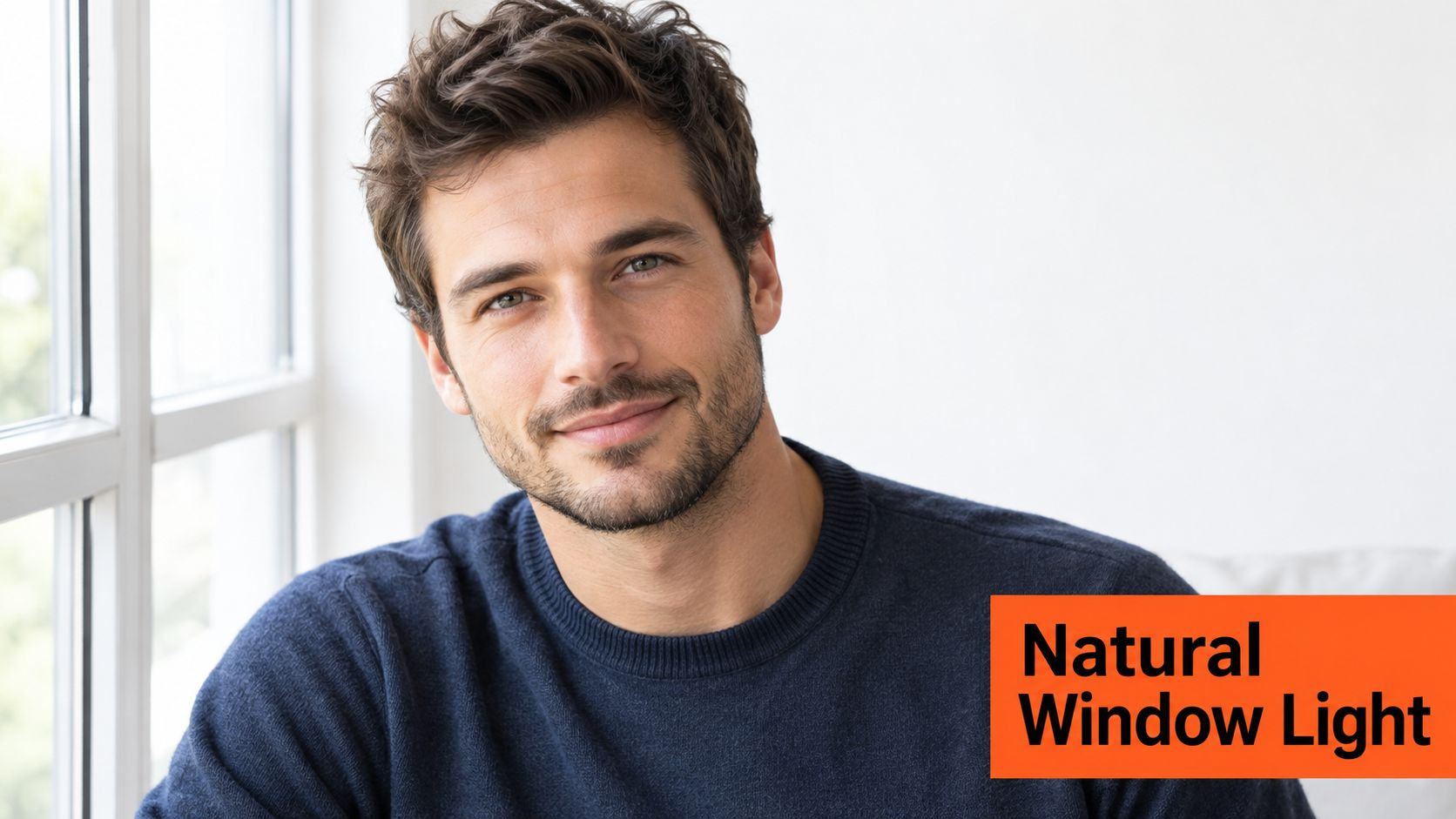
Shot well, it costs nothing beyond a bright room. Face the window at a 45-degree angle, never directly into it, and shoot mid-morning or late afternoon for steady light. Direct window light flattens the face and blows out skin detail.
The trade-off is consistency. Cloud cover and time of day shift the light, which makes a full set hard to match across sessions. A set shot over two days can look like two different actors, and that undermines the recognizability casting teams depend on.
Technical standards still apply in natural light. A credible workflow produces a current, color, chest-up portrait with the eyes sharply resolved in the upper third of the frame, with an 8×10-inch vertical file at 300 dpi, approximately 2,400×3,000 pixels, for print, and high quality JPEG in sRGB for digital submission, per the technical specifications for actor headshot files.
Studio note: Window light flatters one frame. It rarely flatters thirty matching frames.
Our system holds lighting consistent across all 30+ outputs in a set, so the look matches from first image to last. That's the practical advantage over chasing daylight.
6. Multi-look comp card
A comp card puts three or four looks on one sheet, varying wardrobe, expression, and lighting to show range. Talent agencies request them for theatrical and commercial submissions, and regional theater auditions use multi-look sets the same way. Casting directors use the sheet to picture you across roles in seconds.
Range has limits. Recent guidance recommends one anchor image plus two or three supporting looks with distinct purposes, rather than several near-duplicates, as discussed in this analysis of choosing primary and supporting acting headshots. Near-duplicates waste the sheet. Unrelated identities waste trust.
Vary expression more than wardrobe, because range reads through the face. Choose one look that matches your strongest casting type and lead with it. Wardrobe supports the lane, it doesn't create it.
What it costs to build
A traditional comp card requires a full studio day with a photographer, hair and makeup, and wardrobe changes. That work is the cost driver, and it's why many actors shoot one comp card every two or three years. A traditional photographer day runs $300 to $600+ per session.
AiHeadshots starts at $29 for a full set of studio-grade images in about 30 minutes, so you can refresh a card without booking a studio. Refresh matters, because an outdated card shows a person who no longer walks into the room.
Platforms reinforce the anchor logic. Backstage lets actors designate one image as the Main Headshot and states that this main image is the first photo job posters see, according to its casting profile guidance on main headshot selection.
7. Direct-gaze, closed-mouth hero headshot
The hero headshot centers on direct eye contact and a restrained expression, either neutral or a slight closed-mouth smile. It's the most-used image in actor headshot sets because the face carries intent without performing for the camera. Photographer Peter Hurley built a well-known following around this direct, minimal expression style, which is why it's often called the Hurley look in headshot circles.
Hero headshots serve as the primary image on agency and casting profiles, and direct gaze portraits anchor corporate headshot sets for executives for the same reason. The expression says present and capable, and nothing louder.
Submission mechanics reward that clarity. One SAG-AFTRA casting notice required the headshot as a JPG with the filename format YOUR_NAME_PHONE#.JPG, expressly rejecting generic names such as Photo1.jpg, as shown in the SAG-AFTRA casting notice submission requirements. Your hero image is an identification file. Name it like one.
Holding the expression
Practice the expression in a mirror before the shoot and pick the one you can hold for 30 seconds. A forced expression collapses after a few frames, and casting teams read the tension immediately. Keep the chin slightly forward and down to sharpen the jawline.
Retouching discipline matters here most. Guidance recommends limiting retouching to color correction and minor blemish cleanup, with every image matching your present hairstyle, facial hair, weight, and age presentation, as set out in the commercial versus theatrical headshot quality standards. The most polished image is useless if the casting team can't reconcile it with the actor in the room.
Upload 10 selfies, see your first headshot in 30 minutes, and start at $29 on AiHeadshots at /try or review plans at /pricing.
7 Headshot Acting Examples Compared
| Headshot Style | 🔄 Implementation Complexity | ⚡ Resource Requirements | 📊 Expected Outcome | Ideal Use Cases | ⭐ Key Advantage |
|---|---|---|---|---|---|
| Neutral backdrop commercial | Low; simple backdrop, soft lighting, direct gaze | Studio or consistent digital setup | Clear, readable, versatile portrait | Commercial, print, and corporate submissions | Easy to scan at thumbnail size |
| Rembrandt lighting character | Moderate; directional light and careful shadow control | Controlled lighting; exposure checks recommended | Dramatic, character-focused image | Thriller, crime, and other intense roles | Communicates presence and intensity |
| High-contrast black-and-white | Moderate; monochrome conversion and tonal balancing | Color source image; editing or conversion | Editorial look emphasizing expression and structure | Theater, editorial, and fine-art submissions | Distinctive visual identity |
| Three-quarter turn | Moderate; coordinated body, head, eye, and light positioning | Basic portrait setup; careful posing | Cinematic view that reveals facial structure | Film and television supporting roles | Adds variety and definition to a headshot set |
| Natural window light | Low; position subject near a suitable window | Window light; no dedicated equipment required | Soft, approachable portrait | Lifestyle, family, and everyday-character roles | Natural look with minimal equipment |
| Multi-look comp card | High; plan and capture several coordinated looks | Multiple outfits and looks; traditional shoots require studio time | Presents a range of casting types on one card | Agency and theatrical or commercial submissions | Shows versatility in a single document |
| Direct-gaze, closed-mouth hero | Low to moderate; tight framing and controlled expression | Simple lighting and a brief posing session | Confident, direct, broadly usable image | Primary agency profiles and commercial, corporate, or screen roles | Strong eye contact works across casting types |
Build one set that shows range without losing clarity
Use the seven examples as a system, not a menu. The neutral commercial shot and the direct-gaze hero shot are your anchors. They handle identification, thumbnails, and first impressions. Everything else supports them.
Add the Rembrandt frame for character lanes, the monochrome frame for editorial and theater contexts, the three-quarter turn for structure, the window-light frame for everyday roles, and the comp card to present the set as one argument. Each addition must answer a specific casting question. If an image doesn't open a distinct lane, cut it. A tight set with clear lanes beats a large set of near-duplicates every time.
Reproduce any of these looks with AiHeadshots in five steps.
- Upload 10 to 20 phone selfies showing your current hair, facial hair, and everyday presentation.
- Choose a look that fits the intended casting lane, commercial, theatrical, character, or editorial.
- Review lighting and expression against the lane, checking that shadow, smile, and gaze send the right signal.
- Select the strongest results from your 30+ studio-grade headshots, favoring distinct purposes over near-duplicates.
- Test the final set at thumbnail size and confirm the eyes stay legible and each lane reads in seconds.
We're photographers who built an AI. AiHeadshots comes from Studio Pod in Houston, founded by photographers Joseph West and Chris Bailey, with 10,000+ real professionals shot since 2019. Pricing starts at $29, delivery runs about 30 minutes, and every order carries a 100% money-back guarantee within 14 days.
Competitors like HeadshotPro, BetterPic, Aragon, Secta, and ProPhotos generate headshots from uploads too. Our edge is photographer heritage, price, and 30 minute delivery. Judge the files at thumbnail size and decide on evidence.
Upload 10 selfies, see your first headshot in 30 minutes, $29 at /try.
Build your anchor commercial shot, hero image, and supporting casting lanes from 10 to 20 phone selfies, with 30+ studio-grade headshots delivered in about 30 minutes starting at $29. Every order is backed by a 100% money-back guarantee within 14 days, so you can judge the set at thumbnail size before you commit. Visit AiHeadshots to create a casting set that shows range without losing clarity.