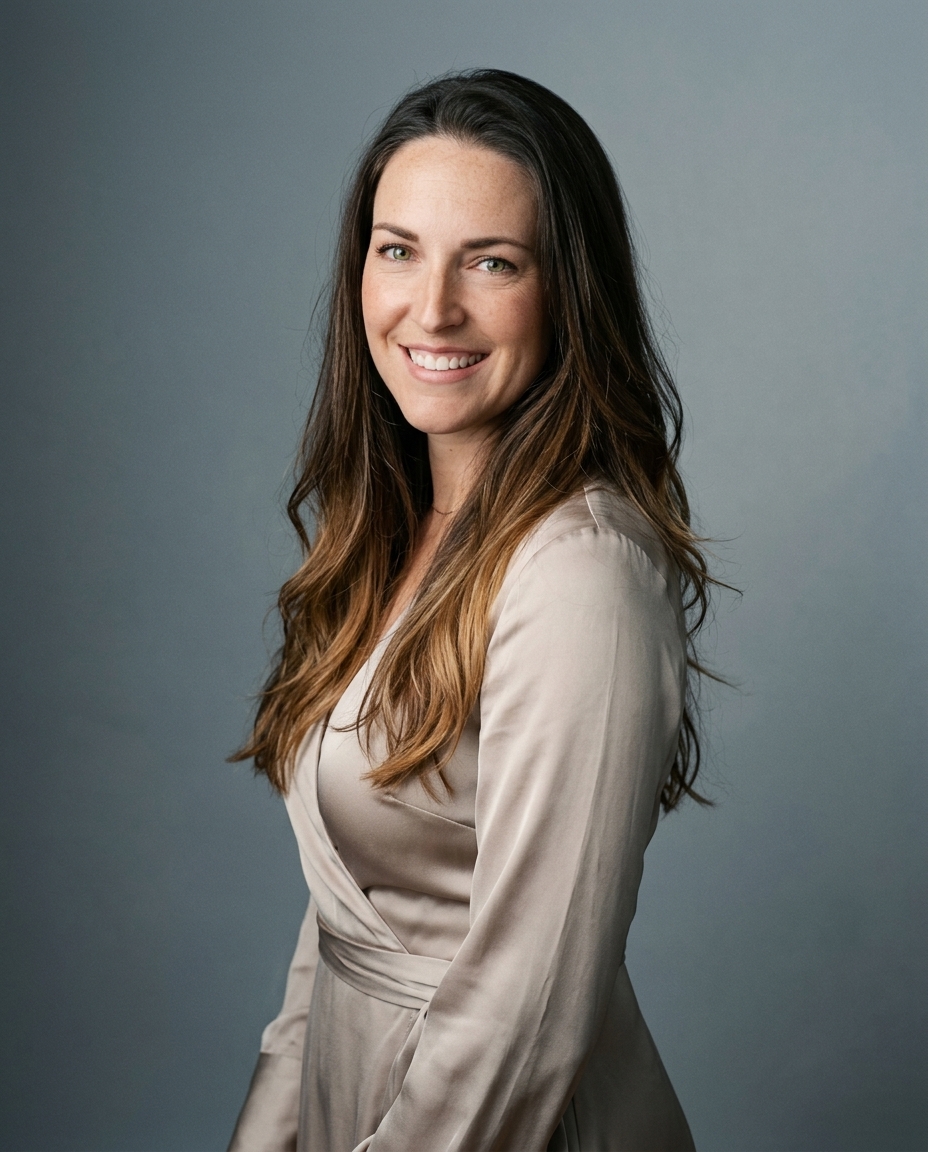
Yes, professional headshots are worth it for most professionals. Profiles with professional photos receive up to 21x more profile views and 36x more messages, while the production choice determines whether that visibility costs a studio-session median of $250 or an AI workflow starting at $29.
That makes the question practical. You aren't choosing between a good photo and a bad photo. You're choosing the right production path for your deadline, budget, role, and required volume. The evidence explains why the image matters, traditional pricing shows the true cost, and the workflow comparison reveals when a photographer or AI headshot service makes more sense.
Table of Contents
- The short answer on headshot value
- What the data says a headshot actually does
- The real cost of a traditional studio session
- Studio photographer vs AI headshots
- When a headshot stops helping
- The team economics of professional headshots
- Your two-minute decision checklist
The short answer on headshot value
A professional headshot earns its keep at the first screening layer. Recruiters, clients, referral partners, and colleagues often see your face on a profile before they read your résumé, bio, or credentials. A credible portrait makes that first click easier. An outdated selfie, cropped group photo, or visibly casual image creates friction before your professional experience gets a chance to speak.
Independent summaries of LinkedIn guidance report that profiles with professional photos can receive up to 21x more profile views and 36x more messages than profiles without them (Frame and Focal). Those figures don't prove that a headshot alone creates a job offer or closes a sale. They show that the image affects entry into the conversation.
The ROI is visibility first, trust second, and aesthetics third.
The cost question changes by use case. A lawyer updating a firm directory, an executive preparing a board bio, and a job seeker with a deadline don't need the same production process. A studio session gives you direction, live feedback, and a photograph made in the room. An AI workflow gives you speed, image volume, and a lower entry price, but it depends on the quality of your source selfies and your ability to choose a believable result.
Your decision should answer four things:
- What does the image need to do? Support discovery, client trust, an executive bio, or a team brand.
- How quickly do you need it? A studio booking can take weeks, while faster digital workflows suit urgent profile updates.
- How many images do you need? One carefully directed portrait is different from consistent images for a whole team.
- What level of human direction matters? High-stakes portraits benefit from a photographer's eye, while routine profile updates often reward speed and flexibility.
What the data says a headshot actually does
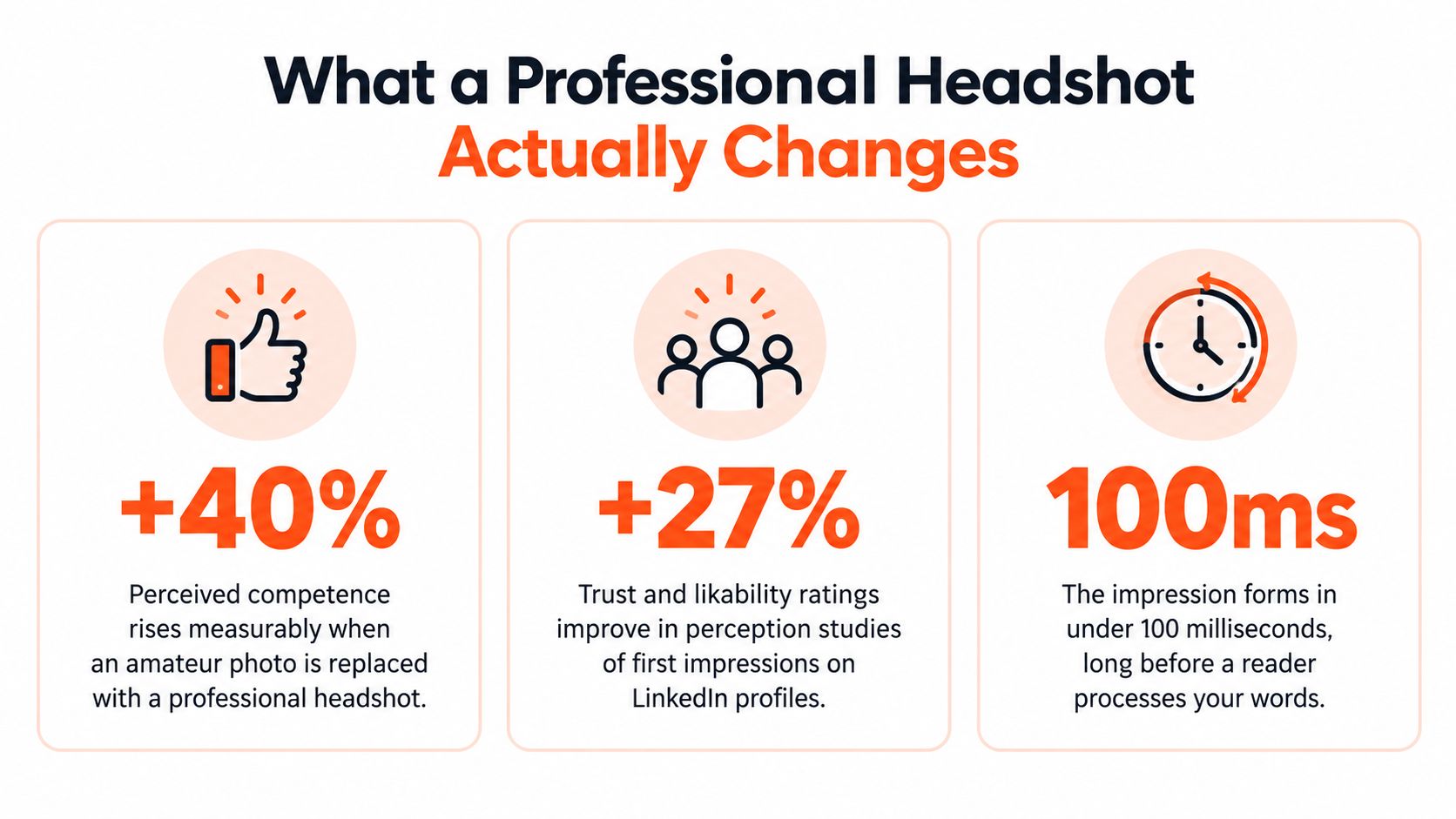
A professional headshot changes how people assess a profile before they read the qualifications. One survey-based study found that replacing an amateur image with a professional portrait raised perceived competence by 76%, likability by 9%, and influence by 62% when respondents saw only the headshot and job title (Headshots Inc.).
The mechanism is immediate. Framing, expression, lighting, clothing, and image quality shape impressions of competence, authority, and approachability. A portrait cannot prove expertise. It can determine whether a viewer gives the rest of the profile enough attention to evaluate it.
Hiring data provides a more concrete test. ResumeGo sent 24,570 fictitious resumes between October 2018 and March 2019. Applicants with complete LinkedIn profiles, including professional headshots, received a 13.5% callback rate, compared with 7.9% for applicants without any LinkedIn profile. That amounted to a 71% relative increase (AI Headshot Reviews).
The practical sequence is simple: a recognizable, compliant photo can encourage a profile visit, and that visit creates an opportunity for a message, connection, or callback. It does not guarantee an outcome. It gives your qualifications more chances to be seen.
Usability affects that result. A well-lit portrait can still fail inside a circular profile frame if the crop makes the face too small. Follow this guide on how to crop LinkedIn profile photos before uploading. The 10,000 headshots study offers further context on recurring portrait patterns across working professionals.
The real cost of a traditional studio session
Traditional photography prices vary because the product isn't only a file. You're paying for a photographer's preparation, direction, lighting, retouching, studio overhead, and judgment. Independent 2026 pricing summaries place traditional studio sessions around $150 to $700+ in most U.S. markets, with a national median near $250 and many mid-market sessions clustering around $300 to $550 (Capturely).
New York City averages roughly $924, and major-market sessions commonly fall in the $450 to $900 range, according to the same pricing coverage. Geography and photographer tier create much of that spread. Retouching depth, licensing terms, outfit changes, background options, and the number of final selections also change the quote.
A photographer's day rate of $300 to $600+ is a useful working benchmark, not a scare figure. It reflects the value of reserving professional time, setting up equipment, coaching subjects, reviewing expressions, and producing finished images. The session fee may not include travel, rush delivery, hair and makeup, additional retouching, or commercial usage.
Time belongs in the price
In-person studio sessions usually take 1 to 3 weeks from booking to delivery (Capturely). That timeline includes more than the camera appointment. You schedule around the photographer, travel to the studio, prepare clothing, complete the shoot, review proofs, and wait for post-production.
That delay is harmless when you're planning a website refresh months ahead. It becomes a real cost when a recruiter requests a current profile, a conference publishes a speaker page, or a new executive needs a public-facing bio before an announcement. The correct comparison is therefore not just session price versus service price. It's total cash cost plus the value of getting a usable image by the deadline.
For a practical breakdown of what a single portrait can include, review how much one professional headshot costs. The question isn't whether traditional photography has value. It does. The question is whether its direction, finish, and timing match the assignment.
Studio photographer vs AI headshots
A studio photographer wins when the portrait carries high reputational stakes and you need live human direction. The photographer can adjust your posture, expression, chin angle, wardrobe, and eye line while watching how each change affects the frame. For an executive portrait, actor portfolio, personal brand campaign, or major website launch, that judgment is often worth paying for.
AI headshots win on speed, volume, and access. With AiHeadshots, you upload 10 to 20 phone selfies, skip the studio visit, and receive 30+ studio-grade headshots in about 30 minutes. Pricing runs from $29 to $59 across the Basic, Professional, and Executive tiers, with a 100% money-back guarantee within 14 days. The product comes from Studio Pod, a Houston automated headshot studio founded by photographers Joseph West and Chris Bailey. The team has shot 10,000+ real professionals since 2019 and built an AI product from photography experience rather than retrofitting open models as a software team.
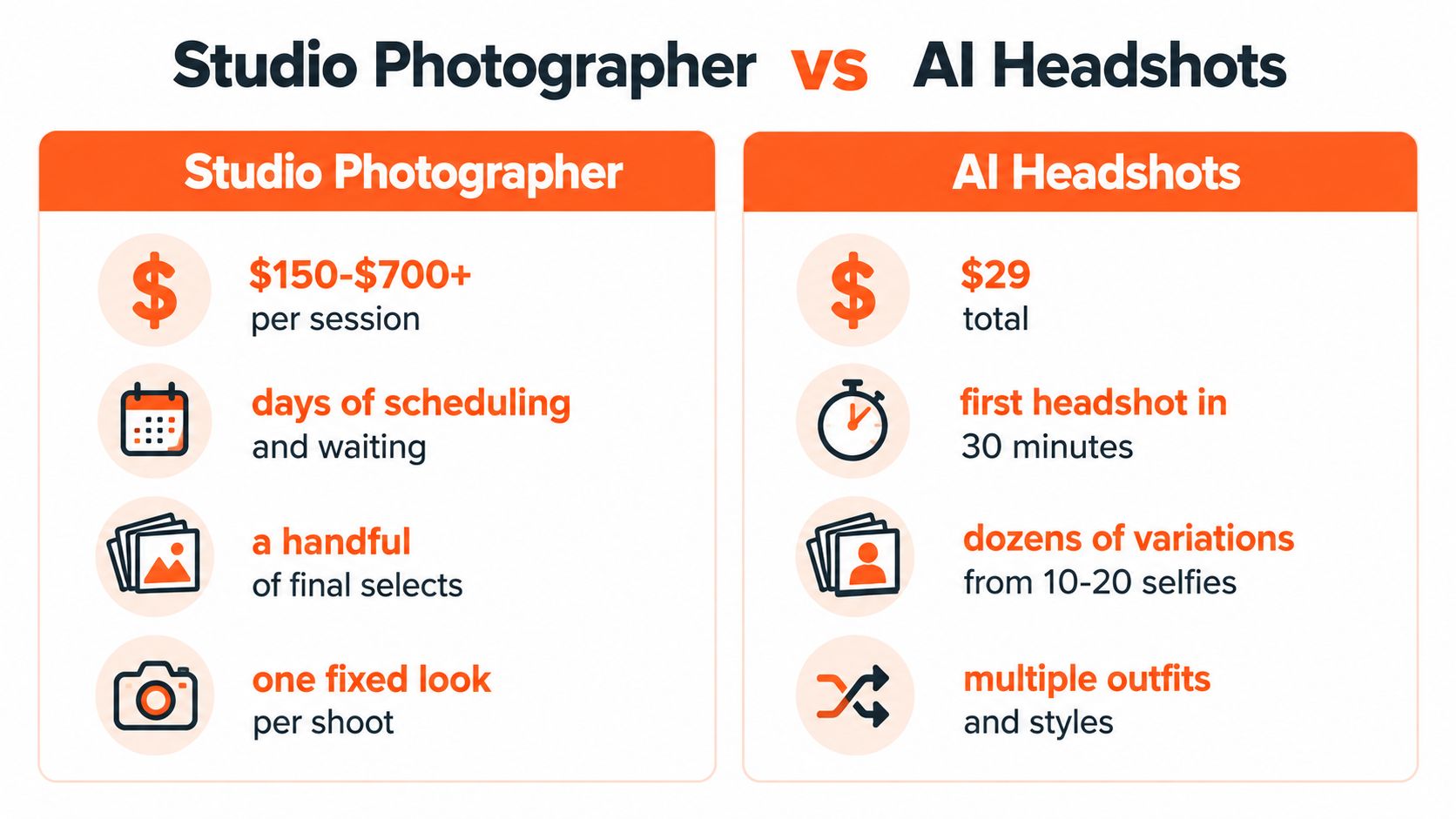
| Factor | Studio photographer | AiHeadshots |
|---|---|---|
| Production | Directed session with live feedback | Upload 10 to 20 phone selfies |
| Location | Studio visit required | No studio visit |
| Delivery | Usually 1 to 3 weeks | About 30 minutes |
| Output | A curated set of final selections | 30+ generated headshots |
| Price | Commonly $150 to $700+ per session | Basic $29, Professional $39, Executive $59 |
| Best fit | High-stakes portraits needing human direction | Fast profile updates, varied looks, and repeatable team images |
The distinction isn't “real photography versus fake photography.” It's directed capture versus generated variation. A photographer controls the moment in front of the lens. AiHeadshots creates options from your submitted images, so the source material and final selection discipline matter.
The AI headshots value comparison covers the broader decision. Watch the workflow difference here:
Choose a studio photographer for a portrait where coaching and authenticity under controlled conditions are the central requirements. Choose an AI workflow for a current, polished profile image when the deadline, price, or number of variations makes a traditional session inefficient.
When a headshot stops helping
A professional headshot stops creating value when it breaks trust. The image can be technically polished and still fail if it no longer resembles you, presents a role you don't occupy, or looks so retouched that viewers question its authenticity.
Recency is the first test. If your hair, glasses, facial hair, weight, age, or usual professional style has changed enough that a client wouldn't recognize you at a meeting, replace the image. A profile photo should reduce uncertainty, not create a mismatch between the screen and the person who appears on a call.
Overproduction is the second failure. Plastic skin, altered facial structure, artificial eyes, and an expression you never use in real life make an image feel wrong. The perception data works because viewers form an inference from a believable portrait. Once the portrait feels manufactured, the same fast judgment mechanism works against you.
If the photo makes people wonder what was changed, it has already lost part of its value.
Platform fit matters too. An editorial fashion image can look out of place on a law-firm directory. A stiff corporate pose can undercut a designer, therapist, photographer, or founder whose work depends on approachability. Match the image to the environment where people will encounter it, including crop, background, wardrobe, and expression.
Technical presentation can also waste a good portrait. A face that disappears inside a circular crop, a low-resolution upload, or a background that competes with the subject weakens the first impression. Use a practical profile image size guide before publishing across LinkedIn, directories, speaker pages, and sales profiles.
The rule is simple. Replace the photo when it no longer looks like you, retouch it less when skin and features look artificial, and choose a style that agrees with the expectations of your role. A headshot earns its cost through credibility, not polish alone.
The team economics of professional headshots
Team headshots create a coordination problem before they create a photography problem. A leadership group, sales department, or company directory requires calendar planning, locations, wardrobe guidance, approvals, cropping, file delivery, and a process for future replacements.
The financial value comes from consistency and reduced administration. Matching backgrounds, lighting direction, framing, and visual tone make leadership pages and sales materials look intentional. A shared standard also means HR or operations spends less time chasing usable photos, correcting mismatched files, and asking employees to resubmit images.
AiHeadshots Teams offers volume pricing at 10+ seats, with rates of $22 to $29 per seat. That cost structure differs sharply from booking a traditional studio session for every employee. A photographer remains the better fit for a brand campaign that needs on-site direction, controlled lighting, and a specific visual concept. A scalable workflow fits distributed staff, rapid onboarding, and teams that need a consistent standard without scheduling a company-wide studio day.
The market is shifting in 2026 toward repeatable headshot production for teams, as described in this Capturely team headshot ROI overview. The operating process is straightforward: HR or operations defines the visual style, collects source images, reviews the results, and distributes approved portraits. That workflow separates image production from everyone's calendar.
Data handling is part of the decision
Per-seat pricing does not answer the data question. HR teams should confirm how source photos, generated outputs, and billing records are retained before approving a company-wide workflow. AiHeadshots retains input photos for 7 days, outputs for 30 days, and billing records for 90 days, according to the product details provided here.
A separate provider's security overview shows why retention policies need direct review. It describes automatic deletion of uploaded inputs after 30 days, output availability through the active account period, and full PII erasure within 14 days after confirmed account deletion.
For a team rollout, confirm four ownership points: brand standards, image approval, retention rules, and replacement steps when an employee leaves. Review the AiHeadshots Teams workflow and the study discussed earlier before making the process standard. The right choice depends on headcount, deadlines, brand requirements, and how much coordination the company can absorb.
Your two-minute decision checklist
Run these checks before you pay for a portrait.
- Profile-first evaluation: Do recruiters, clients, or referral partners see you on LinkedIn, a directory, a speaker page, or a sales profile before meeting you? If yes, the visibility evidence makes a credible headshot a practical business asset.
- Believability: Does your current photo still look like you, and does it fit your role? If not, replace it before optimizing file dimensions. A polished mismatch is still a mismatch.
- Deadline: Do you need a usable image in about 30 minutes, or can you wait through a studio booking and 1 to 3 week delivery window? Match the production route to the actual deadline.
- Budget band: Is $29 appropriate for a fast AI portrait, or does your assignment justify a $300 to $600+ photographer day-rate benchmark? Include travel, retouching, and scheduling in the comparison.
- Volume: Do you need one portrait or consistent images across a team? For a broader professional update, pair the portrait with an AI resume builder so your profile materials present the same current positioning.
Upload 10 selfies, see your first headshot in 30 minutes, $29.
AiHeadshots provides 30+ studio-grade headshots from 10 to 20 phone selfies, with Basic, Professional, and Executive options from $29 to $59. Visit AiHeadshots to choose a fast profile update or a scalable team workflow that fits the job.